A Levels Chemistry (9701)•9701/12/M/J/18
A Levels Chemistry (9701) — 9701/12/M/J/18, Question 5
The gases X and Y react to form Z. X(g) + Y(g) → Z(g) An equilibrium mixture of these gases is compressed at constant temperature. What will be the changes in the mole fraction of Z and in Kp?
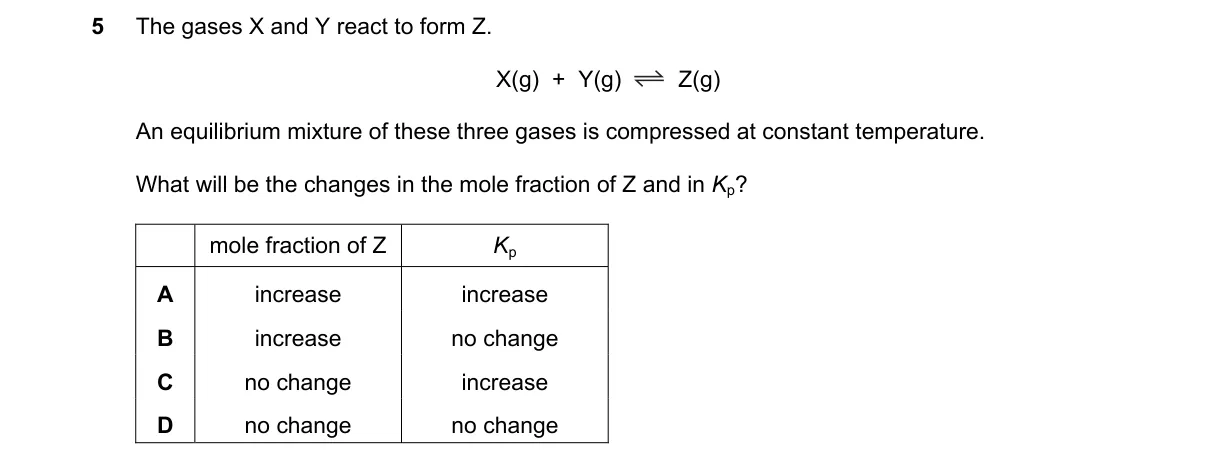
Answer choices
- Aincrease, increase
- Bno change, no change
- Cdecrease, increase
- Dno change, no change
Explanation
Isothermal compression leaves Kp unchanged and mole fractions initially unaltered
Steps:
- Recognize that Kp depends solely on temperature; constant T means Kp unchanged.
- Note compression decreases volume, raising total pressure proportionally for all gases.
- Understand mole fraction of Z is moles Z divided by total moles, unaffected immediately by volume change.
- Conclude no shift in composition is implied without specifying re-equilibration time, so no change in mole fraction.
Why B is correct:
- Kp is defined as a function of temperature only (van't Hoff equation), and mole fractions depend on relative moles, which don't alter instantly upon compression.
Why the others are wrong:
- A: Kp cannot increase at constant T.
- C: Mole fraction of Z cannot decrease; compression favors no immediate drop.
- D: Identical to B, so not distinct.
Final answer: B
Topic: Equilibria
Practice more A Levels Chemistry (9701) questions on mMCQ.me