A Levels Chemistry (9701)•9701/12/M/J/18
A Levels Chemistry (9701) — 9701/12/M/J/18, Question 36
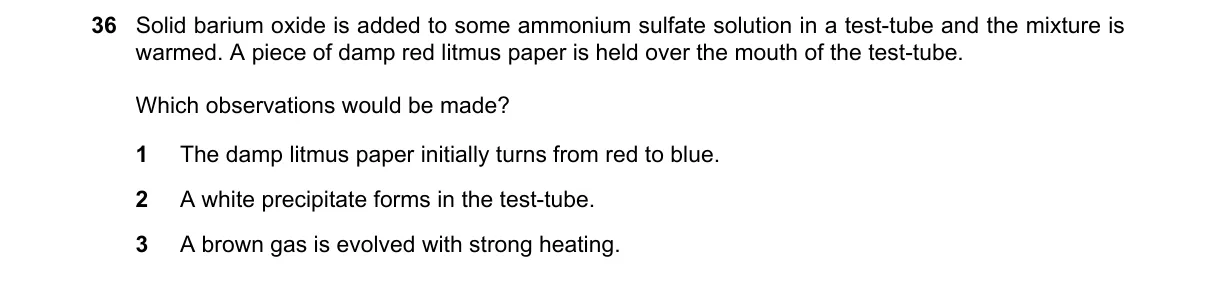
Solid barium oxide is added to some ammonium sulfate solution in a test-tube and the mixture is warmed. A piece of damp red litmus paper is held over the mouth of the test-tube. Which observations would be made?
Answer choices
- AThe damp litmus paper initially turns from red to blue.
- BA white precipitate forms in the test-tube.
- CA brown gas evolves with strong heating.
- DOption D
Explanation
Barium oxide reacts with ammonium sulfate to form a white precipitate
Steps:
- Reactants are solid BaO and aqueous (NH4)2SO4.
- Reaction: BaO(s) + (NH4)2SO4(aq) → BaSO4(s) + 2NH3(g) + H2O(l).
- BaSO4 is insoluble, forming a white precipitate in the test tube.
- Warming drives the reaction forward, producing the observable precipitate.
Why B is correct:
- Barium sulfate (BaSO4) is a white, insoluble solid per solubility rules, precipitating immediately upon reaction.
Why the others are wrong:
- A: Ammonia gas evolves and turns damp red litmus blue, but "initially" implies before warming, when no gas forms yet.
- C: No nitrogen oxides form; brown gas (NO2) requires nitrates and strong oxidation, absent here.
Final answer: B
Topic: Group 2
Practice more A Levels Chemistry (9701) questions on mMCQ.me