A Levels Chemistry (9701)•9701/12/M/J/18
A Levels Chemistry (9701) — 9701/12/M/J/18, Question 25
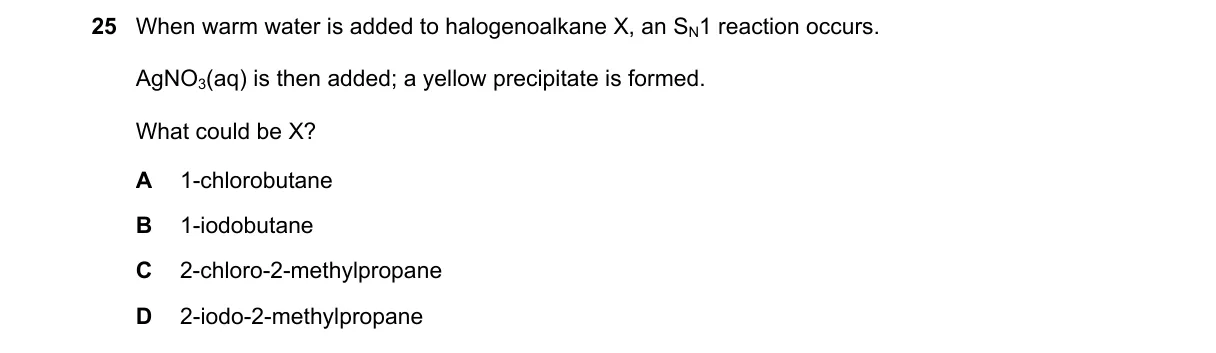
When warm water is added to halogenoalkane X, SN1 reaction occurs. AgNO3(aq) is then added; a yellow precipitate is formed. What could X be?
Answer choices
- A1-chlorobutane
- B1-iodobutane
- C2-chloro-2-methylpropane
- D2-iodo-2-methylpropane
Explanation
SN1 hydrolysis of tertiary iodoalkane yields I⁻, forming yellow AgI precipitate
Steps:
- SN1 reaction with warm water requires tertiary halogenoalkane, as it proceeds via carbocation intermediate.
- Hydrolysis produces alcohol and halide ion (X⁻).
- Adding AgNO₃(aq) to the mixture tests for X⁻ via precipitation of AgX.
- Yellow AgI precipitate identifies X as iodide (AgCl white, AgBr pale yellow/cream).
Why D is correct:
- 2-iodo-2-methylpropane is tertiary iodide; SN1 favored by 3° structure, and AgI forms yellow ppt per solubility rules (AgI least soluble, yellow color).
Why the others are wrong:
- A: Primary chloride favors SN2, not SN1; AgCl white ppt.
- B: Primary iodide favors SN2, not SN1; doesn't meet reaction condition.
- C: Tertiary chloride undergoes SN1, but AgCl white ppt.
Final answer: D
Topic: Halogen compounds
Practice more A Levels Chemistry (9701) questions on mMCQ.me