A Levels Chemistry (9701)•9701/12/M/J/18
A Levels Chemistry (9701) — 9701/12/M/J/18, Question 23
Primary haloalkanes undergo hydrolysis reactions. Which reaction would occur most rapidly if they are all warmed to the same temperature?
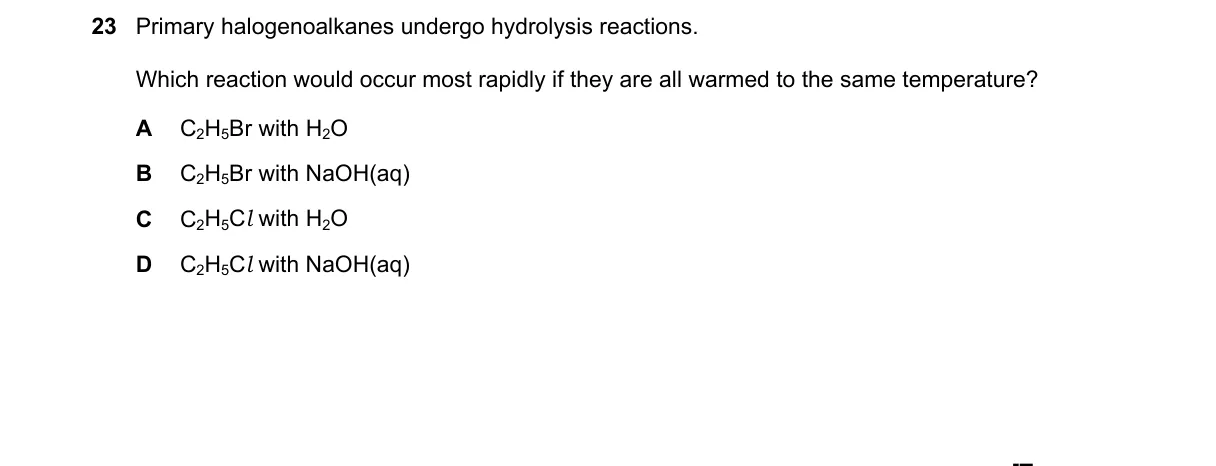
Answer choices
- ACH3Br + H2O
- BCH3CH2Br + NaOH(aq)
- CCH3CH2CH2Cl + NaOH(aq)
- DCH3CH2CH2CH2Cl + NaOH(aq)
Explanation
SN2 Hydrolysis Rate in Primary Haloalkanes
Steps:
- Identify mechanism: Primary haloalkanes undergo SN2 hydrolysis, rate = k[alkyl halide][nucleophile].
- Compare nucleophiles: H2O (A) is weak; OH⁻ (B–D) is strong, so B–D faster than A.
- Assess leaving groups: Br⁻ (B) leaves easier than Cl⁻ (C, D) due to weaker C–Br bond.
- Consider chain length: Minimal steric effect in primaries, but C2 (B) slightly faster than C3 (C) or C4 (D).
Why B is correct:
- B uses strong nucleophile OH⁻ and best leaving group Br⁻ among options, maximizing SN2 rate per bond strength trend (C–I > C–Br > C–Cl).
Why the others are wrong:
- A: Weak nucleophile H2O leads to slow neutral hydrolysis.
- C: Cl⁻ poorer leaving group than Br⁻ slows rate despite OH⁻.
- D: Cl⁻ and longer chain slightly increase steric hindrance, slowing more than C.
Final answer: B
Topic: Halogen compounds
Practice more A Levels Chemistry (9701) questions on mMCQ.me