A Levels Chemistry (9701)•9701/12/M/J/18
A Levels Chemistry (9701) — 9701/12/M/J/18, Question 17
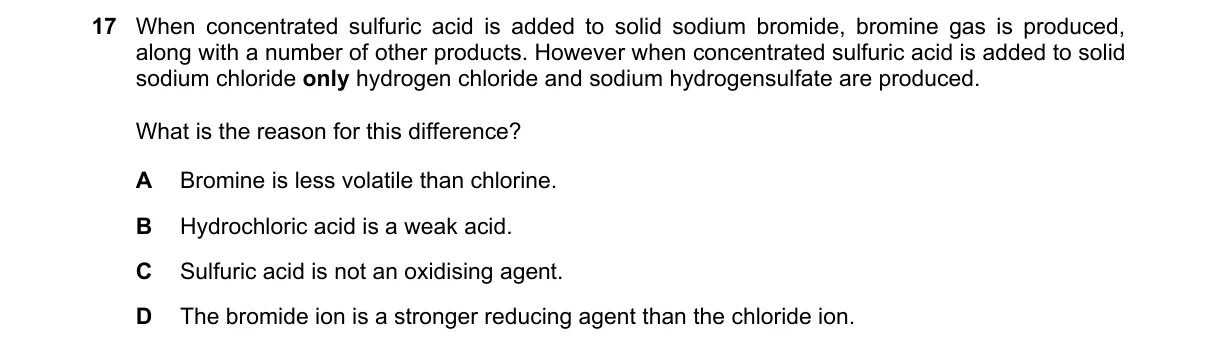
When concentrated sulfuric acid is added to solid sodium bromide, bromine gas is produced, along with a number of other products. However when concentrated sulfuric acid is added to solid sodium chloride only hydrogen chloride and sodium hydrogensulfate are produced. What is the reason for this difference?
Answer choices
- ABromine is less volatile than chlorine.
- BHydrochloric acid is a weak acid.
- CSulfuric acid is not an oxidizing agent.
- DThe bromide ion is a stronger reducing agent than the chloride ion.
Explanation
Redox Strength of Halide Ions
Steps:
- Concentrated H₂SO₄ reacts with NaCl to displace HCl, forming NaHSO₄, as Cl⁻ is not oxidized.
- With NaBr, Br⁻ is oxidized to Br₂ gas, while H₂SO₄ is reduced to SO₂ or H₂S.
- This oxidation occurs because Br⁻ donates electrons more readily than Cl⁻.
- The standard reduction potential for Br₂/Br⁻ (+1.07 V) is lower than Cl₂/Cl⁻ (+1.36 V), making Br⁻ a stronger reducing agent.
Why D is correct:
- Br⁻ reduces H₂SO₄ (E° ≈ +0.17 V for SO₄²⁻/SO₂) to produce Br₂, per the half-reaction 2Br⁻ → Br₂ + 2e⁻, which is favorable unlike for Cl⁻.
Why the others are wrong:
- A: Volatility affects boiling points but not the redox reaction producing Br₂.
- B: HCl is a strong acid; its strength is irrelevant to oxidation.
- C: Concentrated H₂SO₄ oxidizes Br⁻ but not Cl⁻ due to potential differences.
Final answer: D
Topic: Group 17
Practice more A Levels Chemistry (9701) questions on mMCQ.me