A Levels Chemistry (9701)•9701/12/M/J/18
A Levels Chemistry (9701) — 9701/12/M/J/18, Question 14
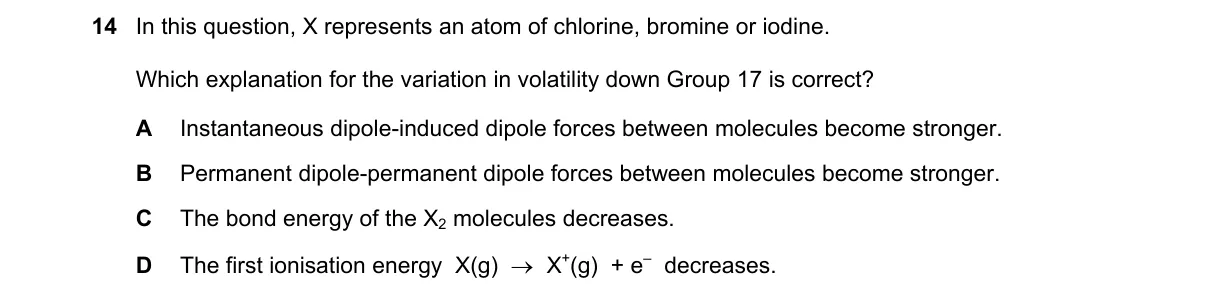
In this question, X represents an atom of chlorine, bromine or iodine. Which explanation for variation in volatility down group 17
Answer choices
- AInstantaneous dipole-induced dipole forces between molecules become stronger.
- BPermanent dipole-permanent dipole forces between molecules become stronger.
- CThe bond energy of the X-X molecules decreases.
- DThe first ionisation energy X(g) → X(g) + e- decreases.
Explanation
Volatility decreases down group 17 due to stronger London dispersion forces
Steps:
- Volatility inversely relates to boiling point; boiling points increase from Cl₂ to I₂.
- Group 17 elements form nonpolar X₂ molecules, so intermolecular forces are instantaneous dipole-induced dipole (London dispersion).
- Atomic size and electron count increase down the group, raising polarizability.
- Stronger dispersion forces require more energy to vaporize, reducing volatility.
Why A is correct:
- London dispersion forces strengthen with larger, more polarizable molecules, as temporary dipoles induce larger opposing dipoles per the definition of induced dipole interactions.
Why the others are wrong:
- B: X₂ molecules are nonpolar, lacking permanent dipoles for permanent dipole forces.
- C: X-X bond energy decreases, but volatility depends on intermolecular (not intramolecular) forces.
- D: Ionization energy decrease affects ion formation, irrelevant to neutral X₂ volatility.
Final answer: A
Topic: Group 17
Practice more A Levels Chemistry (9701) questions on mMCQ.me