A Levels Chemistry (9701)•9701/12/M/J/18
A Levels Chemistry (9701) — 9701/12/M/J/18, Question 10
In a particular reversible reaction the yield of product is increased if the temperature is decreased; the pressure is decreased. Which equation could describe this reversible reaction?
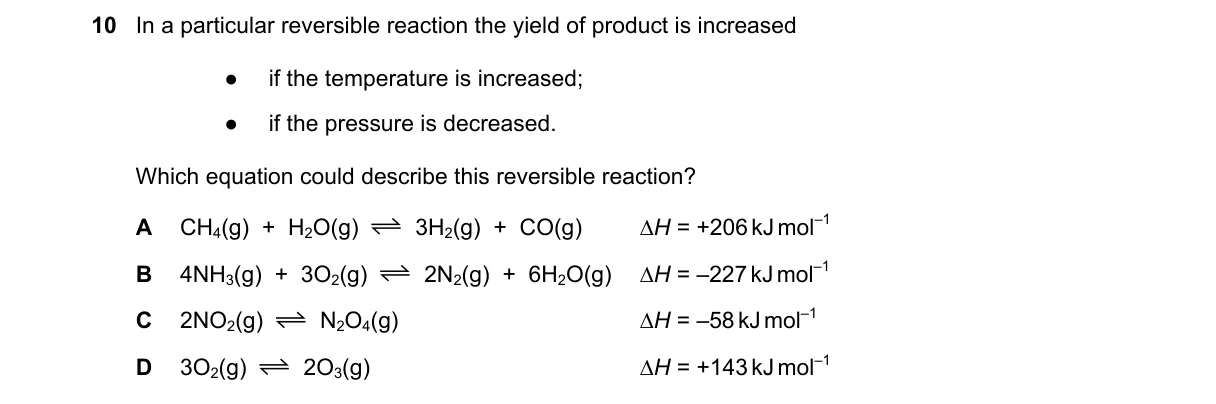
Answer choices
- ACH₄(g) + 2O₂(g) ⇌ H₂O(g) + CO₂(g) ΔH = +206 kJ mol⁻¹
- BN₂H₄(g) + O₂(g) ⇌ N₂(g) + 2H₂O(g) ΔH = -226 kJ mol⁻¹
- C2NO(g) ⇌ N₂(g) + O₂(g) ΔH = -86 kJ mol⁻¹
- D2O₃(g) ⇌ 3O₂(g) ΔH = +143 kJ mol⁻¹
Explanation
Le Chatelier's Principle for Equilibrium Shifts Steps:
- Decreasing temperature increases product yield, so forward reaction must be exothermic (ΔH < 0) to favor products.
- Decreasing pressure increases product yield, so products must have more moles of gas than reactants to favor the side with more particles.
- Examine ΔH and gas moles for each option.
- Only option B has ΔH < 0 and more product moles (3 vs. 2).
Why B is correct:
- Exothermic forward reaction (ΔH = -226 kJ mol⁻¹) shifts right on cooling; more moles on right (3 vs. 2) shifts right on pressure decrease, per Le Chatelier's principle.
Why the others are wrong:
- A: Endothermic (ΔH > 0), so cooling decreases yield; fewer product moles (2 vs. 3), so pressure drop decreases yield.
- C: Exothermic (ΔH < 0), so cooling increases yield, but equal moles (2 vs. 2) means no pressure effect.
- D: Endothermic (ΔH > 0), so cooling decreases yield; more product moles (3 vs. 2) would increase yield on pressure drop, but temperature mismatches.
Final answer: B
Topic: Equilibria
Practice more A Levels Chemistry (9701) questions on mMCQ.me