A Levels Chemistry (9701)•9701/11/M/J/18
A Levels Chemistry (9701) — 9701/11/M/J/18, Question 7
Enthalpy changes of combustion can be used to determine enthalpy changes of formation. The enthalpy equation represents the enthalpy change of formation of butane. 4C(s) + 5H₂(g) = C₄H₁₀(g) By using the following standard enthalpy change of combustion data, what is the value of the standard enthalpy change of formation, ΔH_f, of butane? | Substance | ΔH_c / kJ mol⁻¹ | C(s) | -394 | H₂(g) | -286 | C₄H₁₀(g) | -2877 |
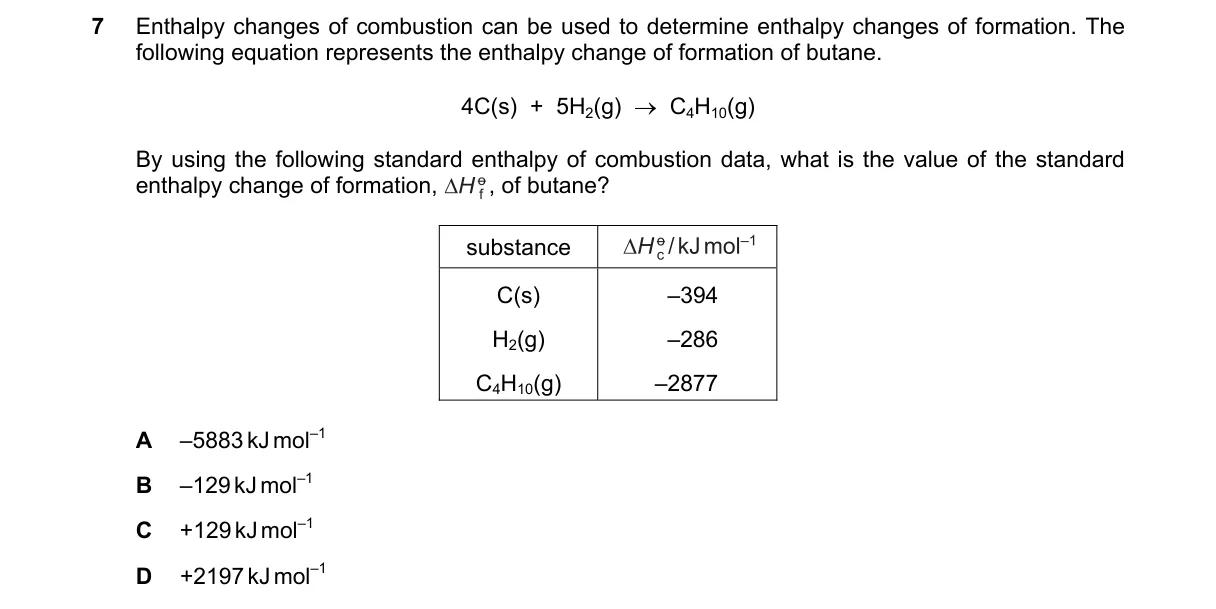
Answer choices
- A-588 kJ mol⁻¹
- B+129 kJ mol⁻¹
- C+219 kJ mol⁻¹
- D+218 kJ mol⁻¹
Explanation
Hess's Law Cycle for Enthalpy of Formation Using Combustion Data Steps:
- Compute total combustion enthalpy for elements: 4 × 394 + 5 × 286 = 1576 + 1430 = 3006 kJ (magnitudes, exothermic).
- Subtract combustion enthalpy of butane: 3006 - 2877 = 129 kJ.
- The positive sign indicates endothermic formation relative to combustion energies.
- Thus, ΔH_f°(C₄H₁₀) = +129 kJ mol⁻¹.
Why B is correct:
- Hess's law states ΔH_f° = Σ(coefficients × |ΔH_c°| of elements) - |ΔH_c°| of compound, yielding +129 kJ mol⁻¹.
Why the others are wrong:
- A: Incorrect; likely misadds 4 × (-394) + 5 × (-286)/something = -3006/5 or error in stoichiometry.
- C: Incorrect; perhaps uses 4 × 286 or wrong H₂ coefficient, overestimating by 90 kJ.
- D: Incorrect; minor arithmetic error in 3006 - 2877, off by 1 kJ.
Final answer: B
Topic: Chemical energetics
Practice more A Levels Chemistry (9701) questions on mMCQ.me