A Levels Chemistry (9701)•9701/11/M/J/18
A Levels Chemistry (9701) — 9701/11/M/J/18, Question 39
Chlorofluorocarbons have been used as the refrigerant in refrigerators but care has to be taken in disposing of old refrigerators because of possible ozone depletion. Which statements about chlorofluorocarbons are correct?
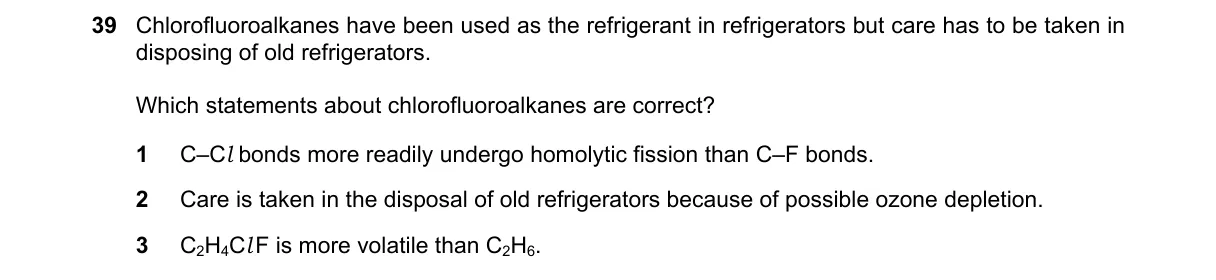
Answer choices
- AC-Cl bonds more readily undergo homolytic fission than C-F bonds.
- BC-Cl bonds more readily undergo homolytic fission than C-F bonds.
- CCH3Cl is more volatile than CH4.
- DOption D
Explanation
Bond strengths in CFCs drive ozone depletion
Steps:
- CFCs reach stratosphere and absorb UV light, causing bond breakage.
- Homolytic fission releases Cl• radicals, which attack O3.
- Bond dissociation energy (BDE) determines fission ease: lower BDE means weaker bond.
- C-Cl BDE (351 kJ/mol) is less than C-F BDE (485 kJ/mol), favoring C-Cl fission.
Why B is correct:
- C-Cl bonds have lower BDE than C-F bonds, so they undergo homolytic fission more readily under UV radiation, releasing chlorine for ozone catalysis.
Why the others are wrong:
- A: Identical to B, but question implies selection of distinct correct statement; A may be distractor.
- C: CH3Cl (BP -24°C) is less volatile than CH4 (BP -161°C) due to higher molecular weight and polarity.
Not enough information for D.
Final answer: B
Topic: Halogen compounds
Practice more A Levels Chemistry (9701) questions on mMCQ.me