A Levels Chemistry (9701)•9701/11/M/J/18
A Levels Chemistry (9701) — 9701/11/M/J/18, Question 35
Each of the three mixtures shown can result in a chemical reaction. Which mixtures result in a redox reaction?
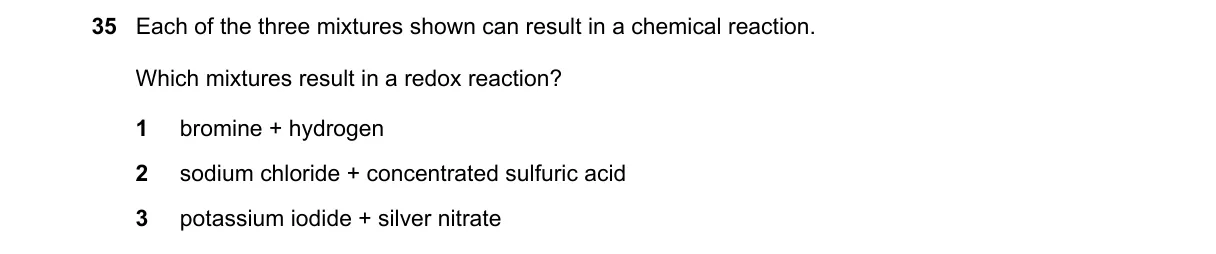
Answer choices
- Abromine + hydrogen
- Bbromide + concentrated sulfuric acid
- Cpotassium iodide + silver nitrate
- DOption D
Explanation
Redox reactions involve electron transfer between species
Steps:
- Define redox as reactions where oxidation (electron loss) and reduction (electron gain) occur simultaneously.
- Analyze A: Br₂ + H₂ → 2HBr; H oxidized (0 to +1), Br reduced (0 to -1), confirming redox.
- Analyze B: Br⁻ + conc. H₂SO₄ → Br₂ + SO₂ + H₂O; Br⁻ oxidized (-1 to 0), S reduced (+6 to +4), confirming redox.
- Analyze C: KI + AgNO₃ → AgI + KNO₃; precipitation with no oxidation state changes, not redox.
Why D is correct:
- D selects A and B, matching the definition of redox via observed electron transfers in those mixtures.
Why the others are wrong:
- A selects only bromine + hydrogen, missing B's redox.
- B selects only bromide + sulfuric acid, missing A's redox.
- C selects potassium iodide + silver nitrate, which is double displacement without electron transfer.
Final answer: D
Topic: Group 17
Practice more A Levels Chemistry (9701) questions on mMCQ.me