A Levels Chemistry (9701)•9701/11/M/J/18
A Levels Chemistry (9701) — 9701/11/M/J/18, Question 33
Calcium reacts with water to form calcium hydroxide and hydrogen. Ca(s) + 2H2O(l) → Ca(OH)2(s) + H2(g) The standard enthalpy change for this reaction is -414 kJ mol^{-1}. What further information is needed for the reaction Ca(s) + 2H2O(l) → Ca(OH)2(s) + H2(g) to calculate the standard enthalpy change of formation ΔH_f [Ca(OH)2(s)], ΔH_f [H2O(l)]?
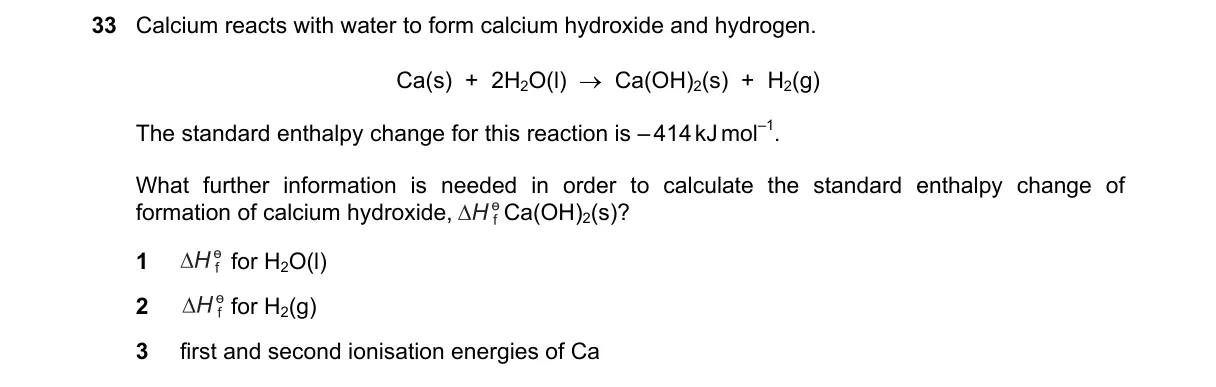
Answer choices
- AΔH_f [Ca(OH)2(s)]
- BΔH_f [H2(g)]
- Cfirst and second ionisation energies of Ca
- DOption D
Explanation
Hess's Law Application to Formation Enthalpy
Steps:
- Apply Hess's law: ΔH_rxn = [ΔH_f(Ca(OH)2(s)) + ΔH_f(H2(g))] - [ΔH_f(Ca(s)) + 2ΔH_f(H2O(l))].
- Set ΔH_f(Ca(s)) = 0 and ΔH_f(H2(g)) = 0, as they are elements in standard states.
- Simplify to ΔH_rxn = ΔH_f(Ca(OH)2(s)) - 2ΔH_f(H2O(l)).
- Solve for ΔH_f(Ca(OH)2(s)) = ΔH_rxn + 2ΔH_f(H2O(l)); requires ΔH_f(H2O(l)).
Why D is correct:
- D supplies ΔH_f[H2O(l)], the missing term in the rearranged formation equation per Hess's law.
Why the others are wrong:
- A: ΔH_f[Ca(OH)2(s)] is the value being calculated, creating circular reasoning.
- B: ΔH_f[H2(g)] = 0 by definition for diatomic hydrogen in standard state.
- C: Ionization energies of Ca pertain to gas-phase atomic processes, unrelated to this bulk reaction enthalpy.
Final answer: D
Topic: Chemical energetics
Practice more A Levels Chemistry (9701) questions on mMCQ.me