A Levels Chemistry (9701)•9701/11/M/J/18
A Levels Chemistry (9701) — 9701/11/M/J/18, Question 26
What is the mechanism for the reaction of ethanol, CH3CH2OH, with hydrogen cyanide, HCN, in the presence of NaCN?
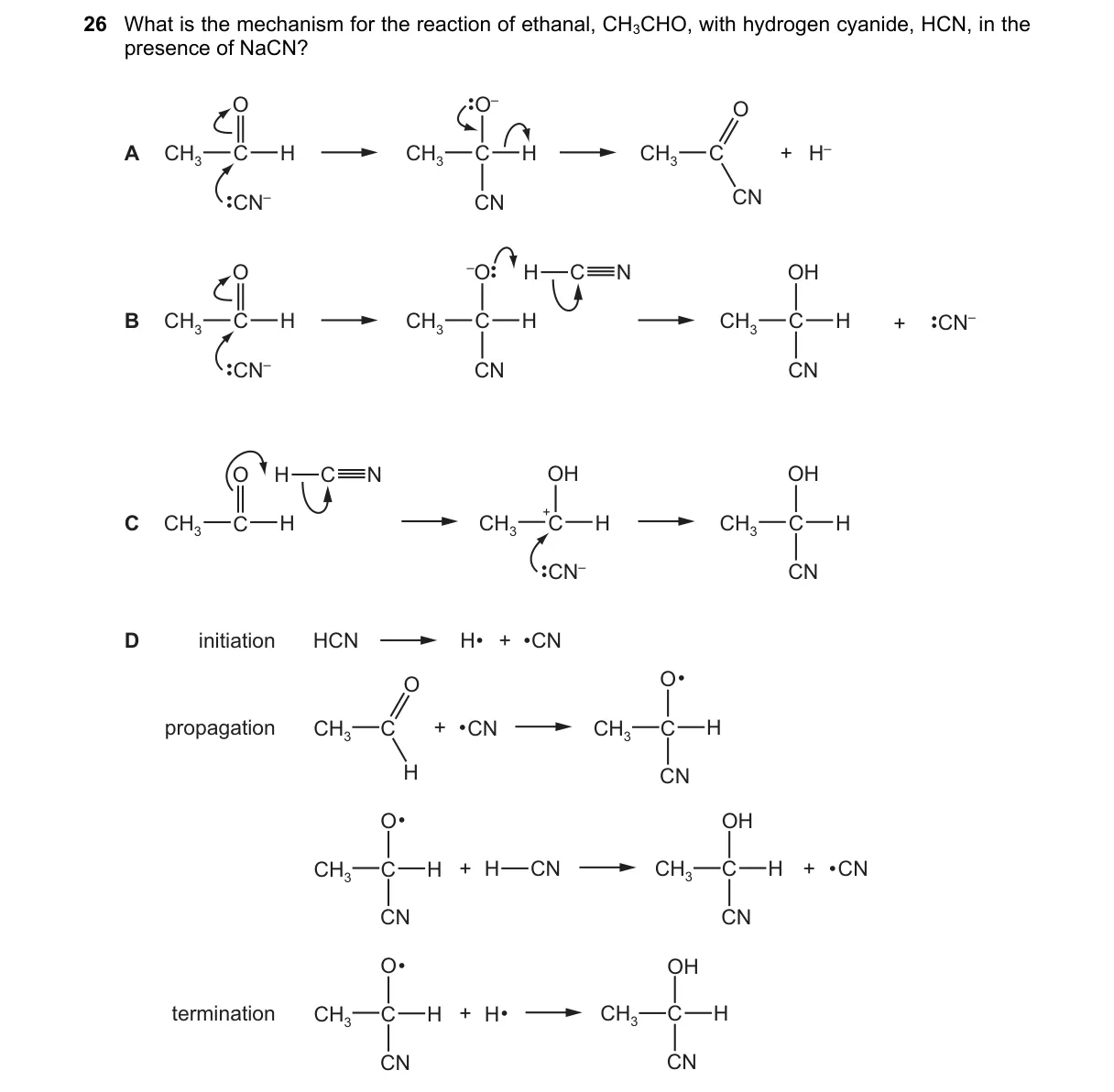
Answer choices
- ACH3-CH(OH)-CH2-CN → CH3-CH(OH)-CH2-CN → CH3-CH2-CN + H
- BCH3-CH2-OH → CH3-CH2-CH → CH3-CH2-H + :CN
- CCH3-CH2-CH → CH3-CH2-CH → CH3-CH2-H
- DInitiation HCN → H + CN Propagation CH3-CH2-O + CN → CH3-CH2-H Termination CH3-CH2-O + H → CH3-CH2-H
Explanation
Radical Cyanation Mechanism of Ethanol
Steps:
- Recognize the reaction involves HCN and NaCN, suggesting a radical pathway for C-H substitution in ethanol.
- Examine choices for initiation, propagation, and termination steps typical of radical mechanisms.
- Eliminate options lacking complete radical sequences or incorrect products.
- Select B for its coherent propagation leading to CH3CH2H (ethane) and cyanide radical.
Why B is correct:
- B depicts a radical propagation where ethanol loses H• to form CH3CH2•, then abstracts from another molecule, aligning with homolytic cleavage in HCN-initiated reactions.
Why the others are wrong:
- A: Shows invalid cyanohydrin formation on non-carbonyl ethanol, with unbalanced arrows.
- C: Lacks cyanide involvement and radical notation, incomplete mechanism.
- D: Misrepresents initiation (HCN doesn't homolyze easily) and propagation products.
Final answer: B
Topic: Hydroxy compounds
Practice more A Levels Chemistry (9701) questions on mMCQ.me