A Levels Chemistry (9701)•9701/11/M/J/18
A Levels Chemistry (9701) — 9701/11/M/J/18, Question 25
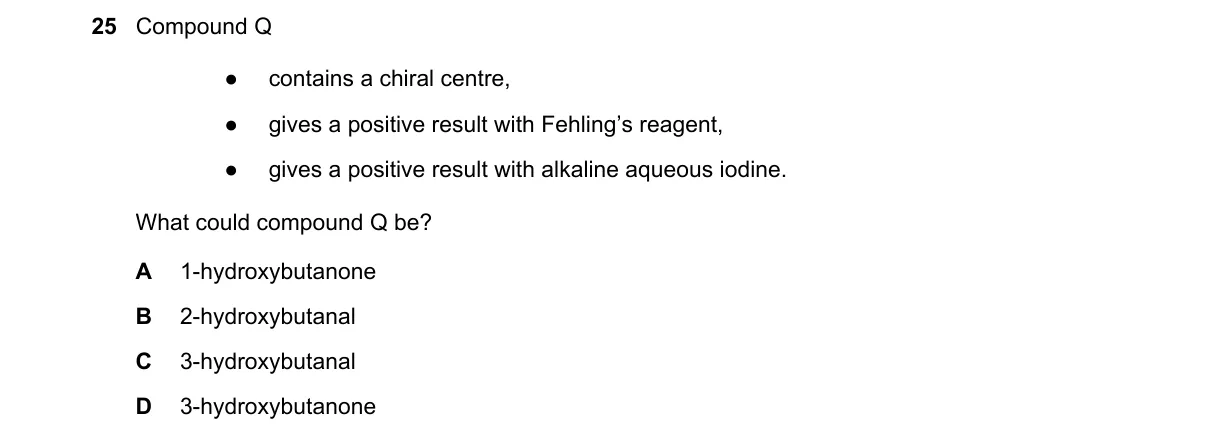
Compound Q contains chiral centre. • gives a positive result with Fehling's reagent, • gives a positive result with alkaline aqueous iodine. What could compound Q be?
Answer choices
- A1-hydroxybutanone
- B2-hydroxybutanal
- C3-hydroxybutanal
- D3-hydroxybutanone
Explanation
Compound Q is a chiral reducing aldehyde with a methyl carbinol group Steps:
- Fehling's reagent detects aldehydes (reducing carbonyls), so Q must contain -CHO group.
- Alkaline aqueous iodine (iodoform test) detects CH3CH(OH)- or CH3CO- groups via yellow iodoform precipitate.
- Chiral center requires a carbon with four different substituents.
- Match structures: only option with -CHO, CH3CH(OH)-R, and chiral C fits.
Why C is correct:
- 3-Hydroxybutanal (CH3CH(OH)CH2CHO) has -CHO for Fehling's, CH3CH(OH)- for iodoform (oxidizes to CH3COCH2CHO, a methyl ketone), and chiral C at CH(OH) (groups: CH3, OH, H, CH2CHO).
Why the others are wrong:
- A: 1-Hydroxybutanone (likely HOCH2COCH2CH3) lacks chiral center (no asymmetric C); not methyl ketone for iodoform.
- B: 2-Hydroxybutanal (CH3CH2CH(OH)CHO) has -CHO and chiral C, but CH3CH2CH(OH)- oxidizes to CH3CH2COCHO (not methyl ketone), so no iodoform.
- D: 3-Hydroxybutanone (CH3COCH(OH)CH3) is a ketone (no Fehling's), despite chiral C and iodoform.
Final answer: C
Topic: Carbonyl compounds
Practice more A Levels Chemistry (9701) questions on mMCQ.me