A Levels Chemistry (9701)•9701/11/M/J/18
A Levels Chemistry (9701) — 9701/11/M/J/18, Question 24
Which reagent could detect the presence of alcohol in a mixture consisting mainly of alkanes and alkenes?
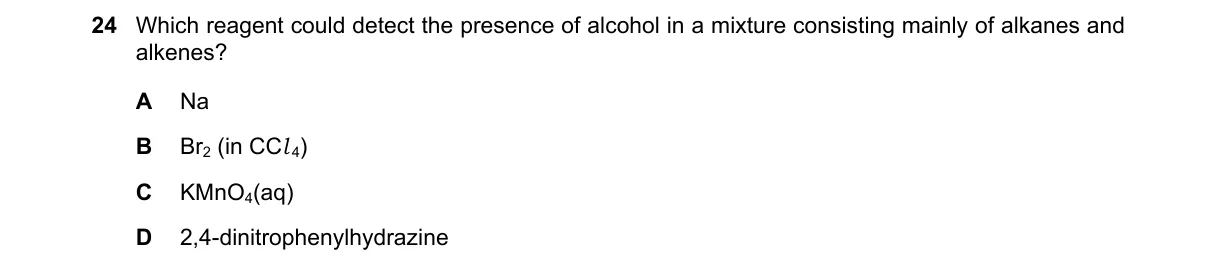
Answer choices
- ANa (in Cl)
- BBr (in Cl)
- CKMnO4 (aq)
- D2,4-dinitrophenylhydrazine
Explanation
Sodium metal selectively reacts with alcohols
Steps:
- Identify the target functional group: alcohols in a mixture with alkanes (saturated) and alkenes (unsaturated).
- Recall reagents for alcohols: sodium metal (Na) reacts to produce hydrogen gas, observable as effervescence.
- Eliminate reagents for alkenes: bromine (Br₂) and KMnO₄ test for unsaturation via decolorization.
- Rule out carbonyl-specific test: 2,4-dinitrophenylhydrazine reacts with aldehydes/ketones, not alcohols.
Why A is correct:
- Sodium (Na) reacts with alcohols via 2ROH + 2Na → 2RONa + H₂, producing visible hydrogen bubbles, while alkanes and alkenes do not react.
Why the others are wrong:
- B: Br₂ (in CCl₄) decolorizes with alkenes due to addition reaction, not specific to alcohols.
- C: KMnO₄ (aq) oxidizes alkenes, causing purple color loss, but ignores alcohols.
- D: 2,4-Dinitrophenylhydrazine forms hydrazones with carbonyls, irrelevant to alcohols.
Final answer: A
Topic: Hydroxy compounds
Practice more A Levels Chemistry (9701) questions on mMCQ.me