A Levels Chemistry (9701)•9701/11/M/J/18
A Levels Chemistry (9701) — 9701/11/M/J/18, Question 22
Sodium methoxide NaCH3O reacts with 2-chloro-2-methylpropane in a nucleophilic substitution reaction. The nucleophile is CH3O-. Which row is correct?
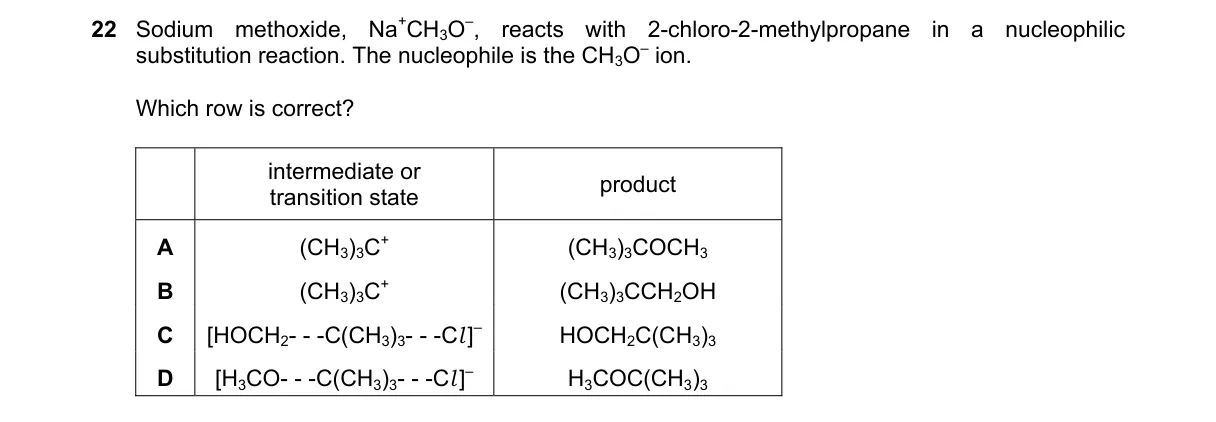
Answer choices
- A(CH3)3C+ (CH3)3COCH3
- B(CH3OCH3-CH3-Cl)- (CH3OCH3CH3)
- C[CH3O-CH(CH3)2-Cl]- HOCH(CH3)2
- D[CH3O-CH2-CH3]-Cl- HOCH2CH3
Explanation
SN1 mechanism for tertiary alkyl halide
Steps:
- Identify substrate: 2-chloro-2-methylpropane is (CH3)3CCl, a tertiary alkyl halide.
- Recognize reaction type: Nucleophilic substitution with CH3O- favors SN1 due to tertiary carbon and stable carbocation.
- SN1 steps: Dissociation forms (CH3)3C+ carbocation and Cl-; then CH3O- attacks carbocation to yield (CH3)3COCH3.
- Match to options: A shows correct carbocation intermediate and substitution product.
Why A is correct:
- Matches SN1: Tertiary halides ionize to form (CH3)3C+ per rate law k[RX], with nucleophile adding to give (CH3)3COCH3 ether.
Why the others are wrong:
- B: Invalid intermediate; resembles SN2 but substrate is tertiary, not primary.
- C: Wrong substrate; shows secondary isopropyl system, not tertiary.
- D: Wrong substrate; depicts primary ethyl system, irrelevant to 2-methylpropane.
Final answer: A
Topic: Halogen compounds
Practice more A Levels Chemistry (9701) questions on mMCQ.me