A Levels Chemistry (9701)•9701/11/M/J/18
A Levels Chemistry (9701) — 9701/11/M/J/18, Question 16
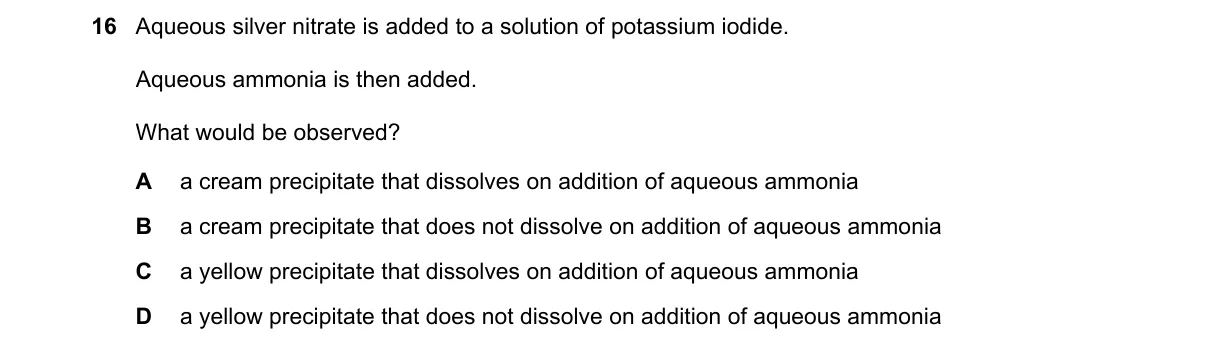
Aqueous silver nitrate is added to a solution of potassium iodide. Aqueous ammonia is then added. What would be observed?
Answer choices
- Aa cream precipitate that dissolves on addition of aqueous ammonia
- Ba cream precipitate that does not dissolve on addition of aqueous ammonia
- Ca yellow precipitate that dissolves on addition of aqueous ammonia
- Da yellow precipitate that does not dissolve on addition of aqueous ammonia
Explanation
Silver iodide formation and insolubility in ammonia
Steps:
- Mix aqueous AgNO₃ with KI: Ag⁺ + I⁻ → AgI (s), a yellow precipitate forms.
- AgI is characteristically yellow, distinguishing it from cream AgCl or pale yellow AgBr.
- Add aqueous NH₃: AgI remains insoluble due to weak complex formation with ammonia.
- Observation: persistent yellow precipitate.
Why D is correct:
- AgI is yellow and insoluble in dilute aqueous ammonia, as its stability prevents dissolution (unlike AgCl forming [Ag(NH₃)₂]⁺).
Why the others are wrong:
- A: Cream color matches AgCl, which dissolves in NH₃; incorrect for iodide.
- B: Cream color is wrong; AgI is yellow, not cream.
- C: AgI does not dissolve in NH₃, so yellow precipitate persists.
Final answer: D
Topic: Analytical techniques
Practice more A Levels Chemistry (9701) questions on mMCQ.me