A Levels Chemistry (9701)•9701/11/M/J/18
A Levels Chemistry (9701) — 9701/11/M/J/18, Question 14
Chlorine reacts with cold aqueous sodium hydroxide to produce sodium chloride, water and compound X. Chlorine reacts with hot aqueous sodium hydroxide to produce sodium chloride, water and compound Y. What are the oxidation states of chlorine in compound X and compound Y?
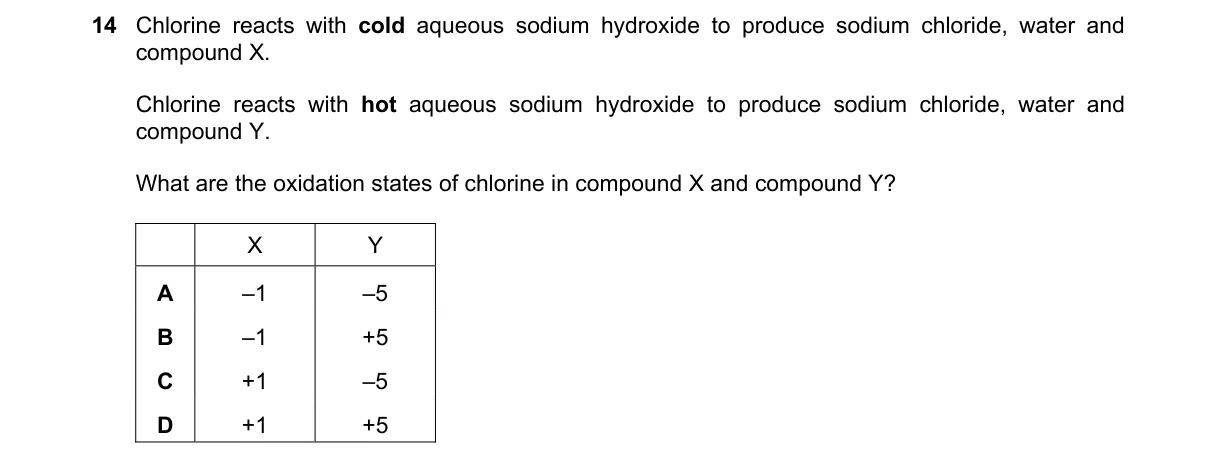
Answer choices
- A-1, -5
- B+1, -5
- C-1, +5
- D+1, +5
Explanation
Disproportionation reactions of chlorine with NaOH at different temperatures
Steps:
- Cold NaOH reaction: Cl₂ + 2NaOH → NaCl + NaClO + H₂O; X is NaClO (hypochlorite).
- In NaClO, Cl oxidation state: let x be Cl state, x - 2 = -1 → x = +1.
- Hot NaOH reaction: 3Cl₂ + 6NaOH → 5NaCl + NaClO₃ + 3H₂O; Y is NaClO₃ (chlorate).
- In NaClO₃, Cl oxidation state: x + 3(-2) = -1 → x = +5.
Why D is correct:
- Oxidation state rules confirm Cl as +1 in ClO⁻ and +5 in ClO₃⁻, matching the products X and Y.
Why the others are wrong:
- A: -5 impossible for chlorine (max +7); Y is +5.
- B: -5 impossible; Y is +5, not -5.
- C: X is +1 (hypochlorite), not -1 (chloride).
Final answer: D
Topic: Group 17
Practice more A Levels Chemistry (9701) questions on mMCQ.me