A Levels Chemistry (9701)•9701/11/M/J/18
A Levels Chemistry (9701) — 9701/11/M/J/18, Question 10
Element X has a higher first ionization energy than element Y. Two students state what they believe is one factor that helps explain this. Student 1: "X has a higher first ionization energy than Y because an atom of X has more". Student 2: "X has a higher first ionization energy than Y because X has a smaller atomic radius than Y." Only one of the students is correct. What could X and Y be?
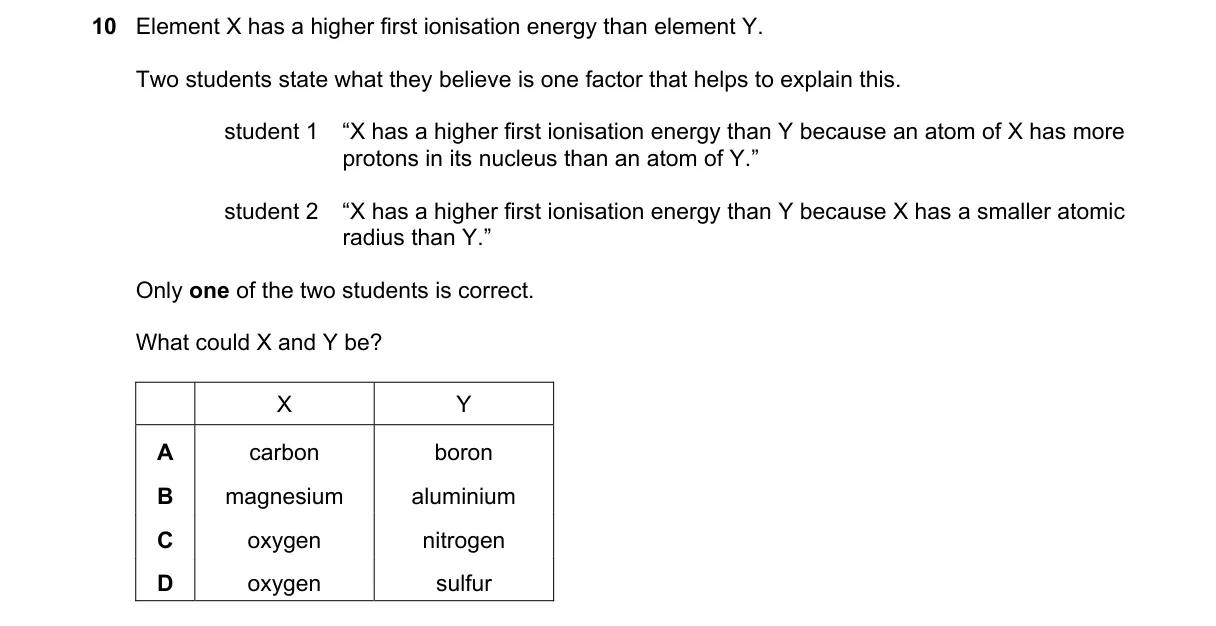
Answer choices
- AX: carbon, Y: boron
- BX: magnesium, Y: aluminum
- CX: aluminum, Y: magnesium
- DX: oxygen, Y: sulfur
Explanation
Periodic trends explain ionization energy differences
Steps:
- Ionization energy increases across periods (higher nuclear charge) and decreases down groups (increased shielding).
- Student 2 is correct if X has smaller radius than Y, as closer electrons are harder to remove.
- Student 1 likely means X has more protons (higher effective nuclear charge), which raises IE.
- Test options: only one student's reason must hold true for the pair.
Why D is correct:
- In group 16, oxygen (X) has higher first IE than sulfur (Y) per the trend of decreasing IE down a group; O's smaller radius (due to less shielding) supports Student 2, while O has fewer protons (8 vs. 16), making Student 1 wrong.
Why the others are wrong:
- A: Carbon has more protons (6 vs. 5) and smaller radius than boron, so both students correct.
- B: Magnesium has higher IE than aluminum but fewer protons (12 vs. 13) and larger radius, so both wrong.
- C: Aluminum has lower IE than magnesium, violating the question premise.
Final answer: D
Topic: The Periodic Table: chemical periodicity
Practice more A Levels Chemistry (9701) questions on mMCQ.me