A Levels Biology (9700)•9700/13/O/N/24
A Levels Biology (9700) — 9700/13/O/N/24, Question 6
The diagram shows a triglyceride. 1 molecule of glycerol, 2 saturated fatty acids and 1 unsaturated fatty acid. What will be the products after hydrolysis of this triglyceride?
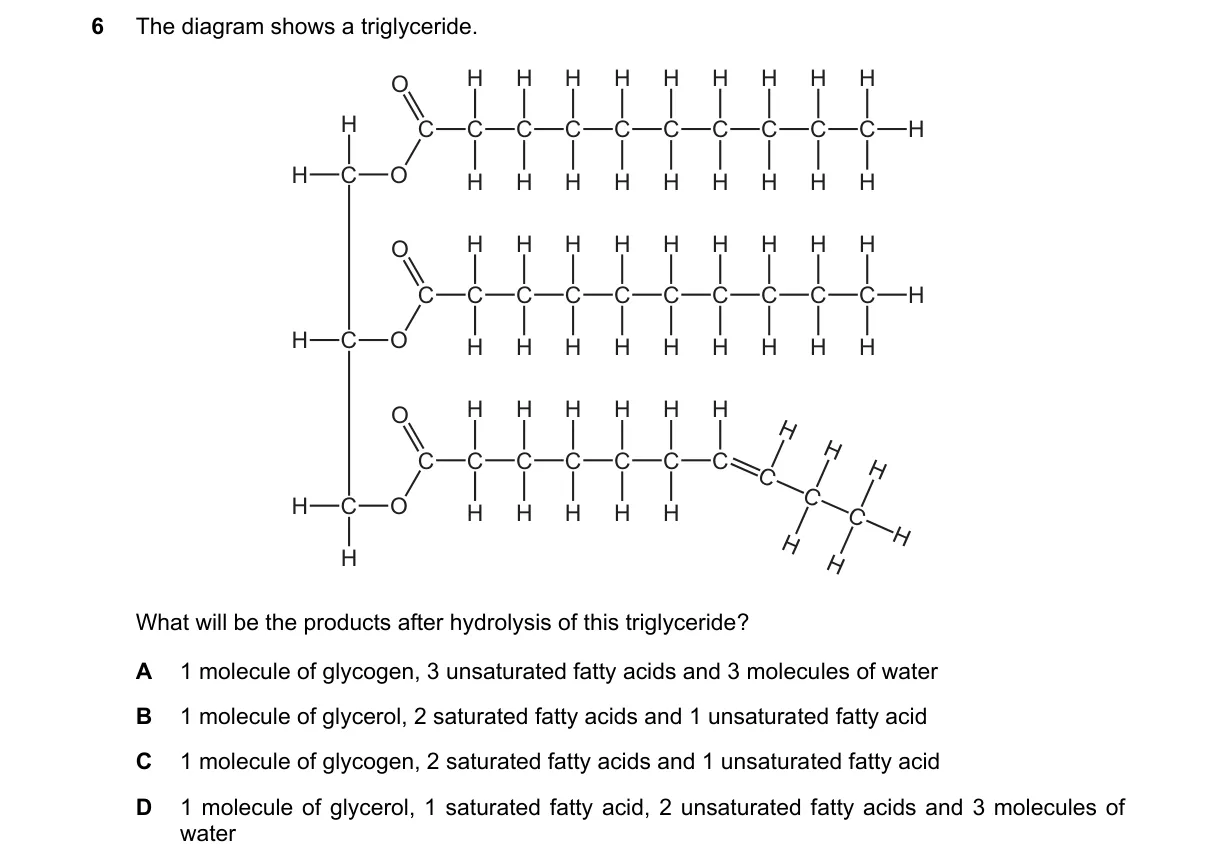
Answer choices
- A1 molecule of glycerol,3 unsaturated fatty acids and 3 molecules of water
- B1 molecule of glycerol,2 saturated fatty acids and 1 unsaturated fatty acid
- C1 molecule of glycogen,3 unsaturated fatty acids and 3 molecules of water
- D1 molecule of glycerol,2 saturated fatty acids and 1 unsaturated fatty acid
Explanation
Hydrolysis breaks triglycerides into glycerol and fatty acids
Steps:
- Triglyceride consists of 1 glycerol bound to 3 fatty acids via ester bonds (2 saturated, 1 unsaturated).
- Hydrolysis adds water to cleave these ester bonds.
- This releases the original components unchanged: 1 glycerol and the 3 fatty acids.
- Water is a reactant, not a product.
Why B is correct:
- By definition, triglyceride hydrolysis yields 1 glycerol and its exact 3 fatty acids (2 saturated, 1 unsaturated), as per the reaction: triglyceride + 3 H₂O → glycerol + 3 RCOOH.
Why the others are wrong:
- A: Lists 3 unsaturated fatty acids (ignores 2 saturated) and water (reactant, not product).
- C: Substitutes glycogen (a polysaccharide) for glycerol and assumes all 3 unsaturated fatty acids.
- D: Identical to B, providing no distinct alternative.
Final answer: B
Topic: Carbohydrates and lipids
Practice more A Levels Biology (9700) questions on mMCQ.me