A Levels Biology (9700)•9700/13/O/N/24
A Levels Biology (9700) — 9700/13/O/N/24, Question 27
Four students have drawn and labelled part of a structure seen on an electron micrograph. Which student has labelled their drawing correctly?
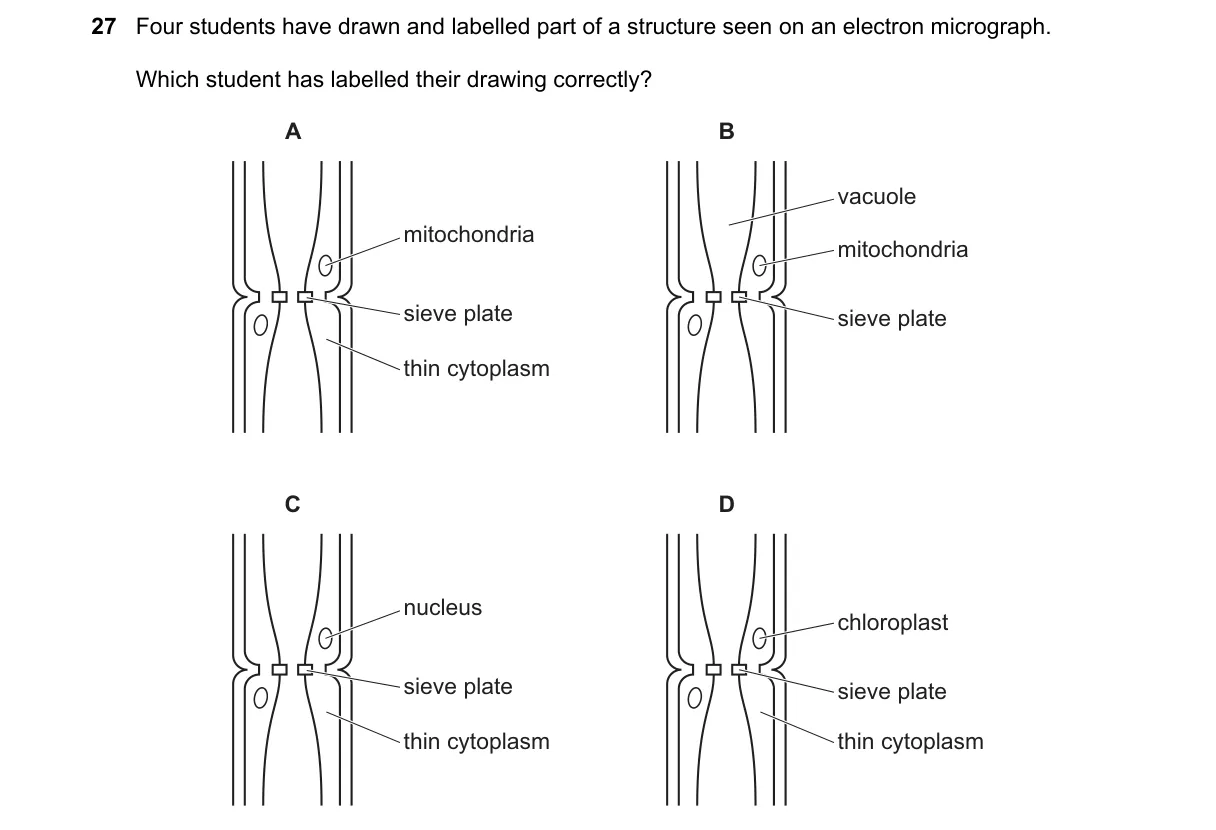
Answer choices
- Amitochondria, sieve plate, thin cytoplasm
- Bvacuole, mitochondria, sieve plate
- Cnucleus, sieve plate, thin cytoplasm
- Dchloroplast, sieve plate, thin cytoplasm
Explanation
Identifying phloem sieve tube features in electron micrographs
Steps:
- Recognize sieve plate as a hallmark of phloem sieve tubes in plants.
- Note that mature sieve tubes have thin peripheral cytoplasm and lack nucleus or large vacuole.
- Identify mitochondria as abundant in associated companion cells for energy needs.
- Match labels to sieve tube characteristics: sieve plate, thin cytoplasm, mitochondria.
Why A is correct:
- Phloem sieve tubes contain sieve plates for transport, thin cytoplasm lining the cell wall, and mitochondria in companion cells, per plant cell ultrastructure.
Why the others are wrong:
- B: Mature sieve tubes lack prominent vacuoles, which dominate in other cell types.
- C: Mature sieve tubes are enucleate, losing their nucleus during differentiation.
- D: Sieve tubes do not contain chloroplasts, which are found in photosynthetic cells.
Final answer: A
Topic: Structure of transport tissues
Practice more A Levels Biology (9700) questions on mMCQ.me