A Levels Biology (9700)•9700/12/O/N/24
A Levels Biology (9700) — 9700/12/O/N/24, Question 7
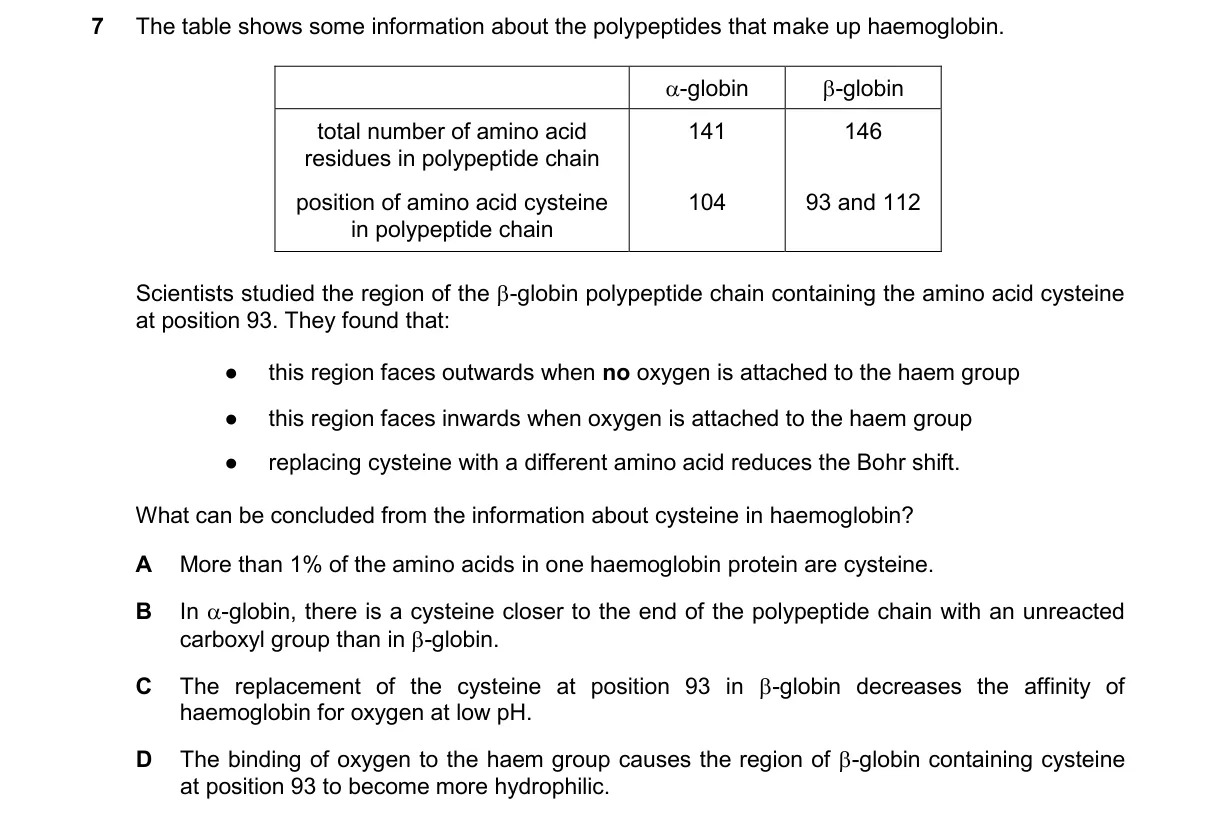
The table shows some information about the polypeptides that make up haemoglobin.
| total number of amino acid residues in polypeptide chain | α-globin | β-globin |
| position of amino acid cysteine in polypeptide chain | 104 | 93 and 112 |
Scientists studied the region of the β-globin polypeptide chain containing the amino acid cysteine at position 93. They found that:
• This region faces outwards when oxygen is attached to the haem group
• This region faces inwards with a different amino acid attached to the Bohr shift.
Answer choices
- AMore than 1% of the amino acids in one haemoglobin protein are cysteine?
- BIn α-globin, there is a cysteine nearer to the end of the polypeptide chain with an unreacted
- CThe replacement of the cysteine at position 93 in β-globin decreases the affinity of
- DThe bonding of oxygen to the haem group causes the region of β-globin containing cysteine at position 93 to become more hydrophilic.
Explanation
Percentage of cysteine in hemoglobin Steps:
- Hemoglobin consists of 2 α-globin (141 residues each) and 2 β-globin (146 residues each), totaling 574 amino acids.
- α-globin has 1 cysteine at position 104, so 2 cysteines from 2 α-chains.
- β-globin has cysteines at positions 93 and 112, so 4 cysteines from 2 β-chains.
- Total cysteines: 6; percentage = (6/574) × 100 ≈ 1.05%, which exceeds 1%.
Why A is correct:
- The calculation (6 cysteines / 574 total residues) × 100% = 1.05% confirms more than 1% are cysteine, based on hemoglobin's quaternary structure.
Why the others are wrong:
- B: Position 104 in 141-residue α-globin is central, not nearer the end; no info on reactivity.
- C: No evidence provided that replacing cysteine at 93 decreases oxygen affinity.
- D: Oxygen binding makes the region face outwards (hydrophilic exposure), but the statement reverses cause and effect; Bohr shift info is ambiguous.
Final answer: A
Topic: Transport of oxygen and carbon dioxide
Practice more A Levels Biology (9700) questions on mMCQ.me