A Levels Biology (9700)•9700/12/O/N/24
A Levels Biology (9700) — 9700/12/O/N/24, Question 6
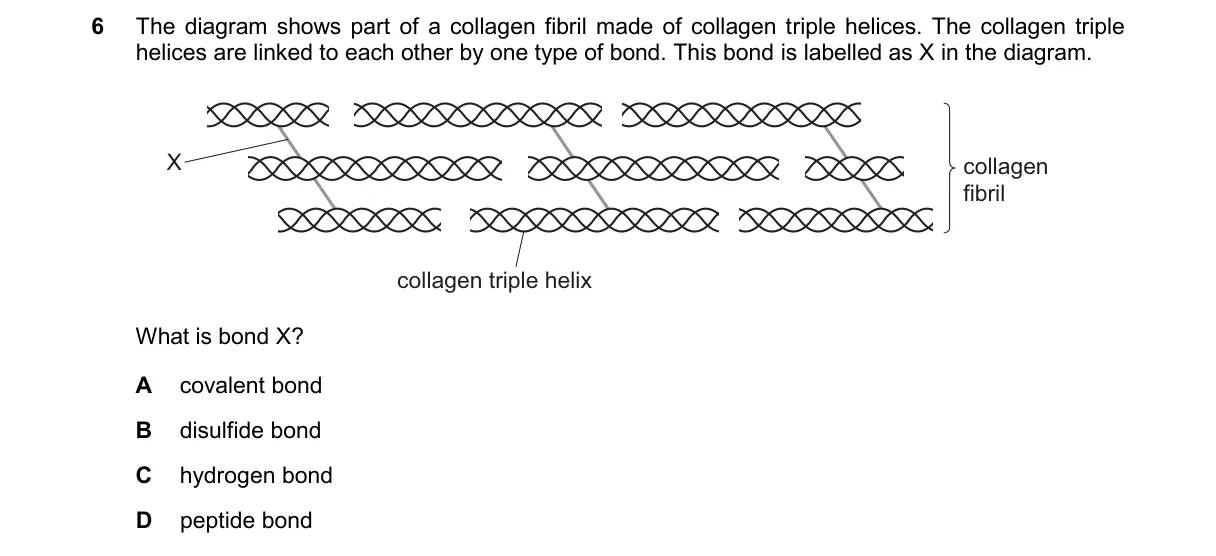
The diagram shows part of a collagen fibril made of collagen triple helices. The collagen triple helices are linked to each other by one type of bond. This bond is labelled as X in the diagram. What is bond X?
Answer choices
- Acovalent bond
- Bdisulfide bond
- Chydrogen bond
- Dpeptide bond
Explanation
Collagen fibrils use covalent cross-links for stability
Steps:
- Collagen triple helices form the basic unit of fibrils, packed laterally.
- In fibrils, helices are staggered and linked by intermolecular bonds for tensile strength.
- Bond X connects adjacent helices, requiring a strong, permanent linkage.
- This matches covalent bonding, as seen in lysine-derived cross-links.
Why A is correct:
- Covalent bonds form stable, irreversible connections between side chains (e.g., via lysyl oxidase enzyme), essential for fibril integrity per biochemical definitions of extracellular matrix proteins.
Why the others are wrong:
- B: Disulfide bonds occur in cysteine-rich proteins like keratin, absent in collagen's glycine-proline-hydroxyproline repeats.
- C: Hydrogen bonds stabilize intra-helix structure within each triple helix, not inter-helix links.
- D: Peptide bonds covalently join amino acids in primary chains, not separate helices.
Final answer: A
Topic: Proteins
Practice more A Levels Biology (9700) questions on mMCQ.me