A Levels Biology (9700)•9700/12/O/N/24
A Levels Biology (9700) — 9700/12/O/N/24, Question 36
A bacterial pathogen produces a protein that acts as a toxin. This toxin is harmful in humans. Scientists are developing monoclonal antibodies that can be used to detect the presence of the toxin in the body so that early treatment can be given. Which steps in the development of these monoclonal antibodies 1 The toxin protein is injected into a mouse and triggers mitosis of specific B-lymphocytes. 2 B-lymphocytes are collected from the spleen of the mouse and fused with myeloma cells. 3 The hybridoma cell produces many antibodies with a variety of different variable regions.
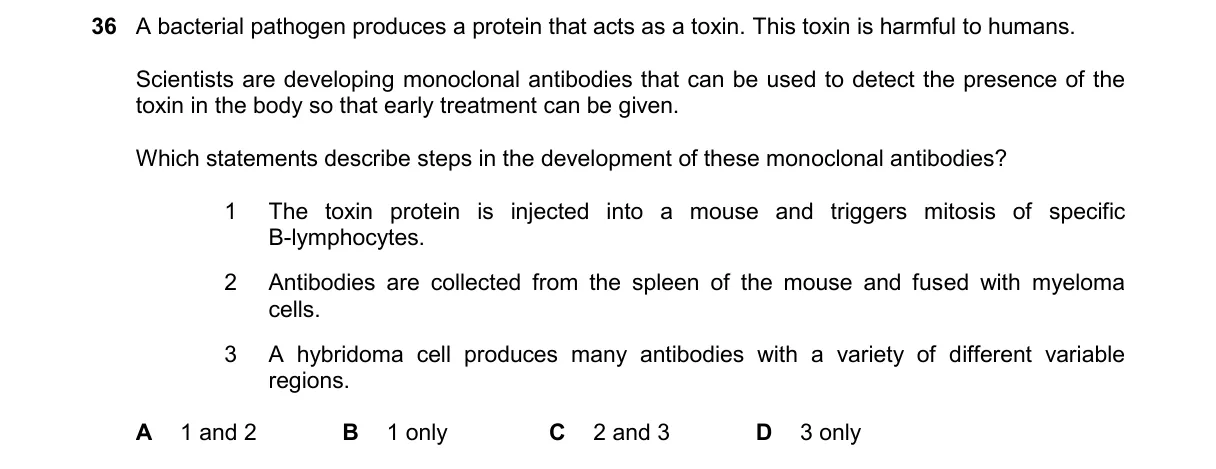
Answer choices
- A1 and 2
- B1 only
- C2 and 3
- D3 only
Explanation
Hybridoma Technology for Monoclonal Antibodies
Steps:
- Inject antigen (toxin) into mouse to stimulate specific B-lymphocytes producing antibodies.
- Collect activated B-lymphocytes from mouse spleen.
- Fuse B-lymphocytes with immortal myeloma cells to form hybridomas.
- Screen hybridomas to select those producing identical antibodies specific to the antigen.
Why B is correct:
- Step 1 accurately describes immunization, which activates specific B-lymphocytes via clonal selection in adaptive immunity.
Why the others are wrong:
- A includes step 2, but it omits the screening for specificity after fusion.
- C includes step 3, but hybridomas produce monoclonal (identical) antibodies, not a variety of variable regions.
- D includes only step 3, which misrepresents hybridoma output as polyclonal rather than monoclonal.
Final answer: B
Topic: Antibodies and vaccination
Practice more A Levels Biology (9700) questions on mMCQ.me