A Levels Biology (9700)•9700/12/O/N/24
A Levels Biology (9700) — 9700/12/O/N/24, Question 34
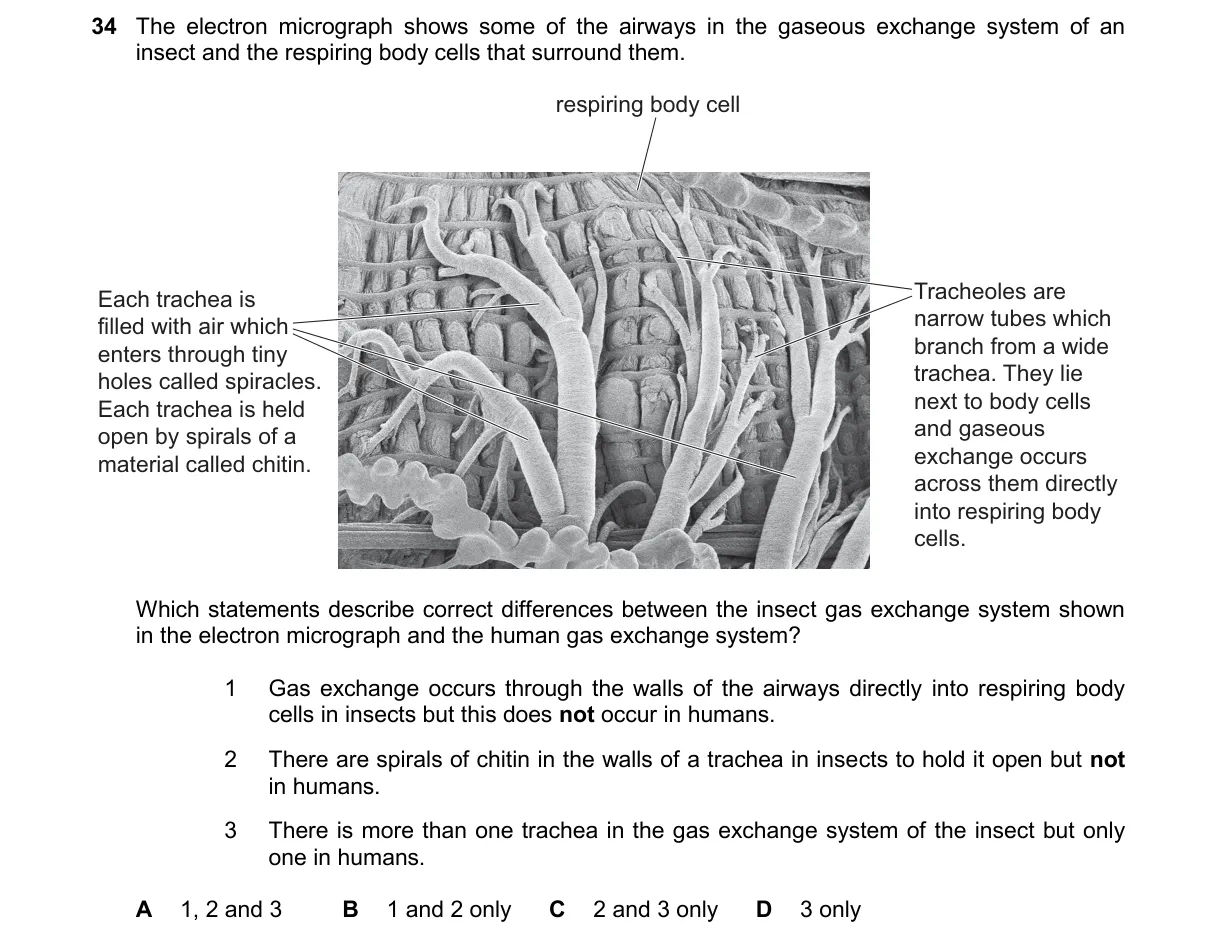
Which statements describe correct differences between the insect gas exchange system shown in the electron micrograph and the human gas exchange system?
1 Gas exchange occurs through the walls of the airways directly into respiring body cells in insects but this does not occur in humans.
2 Chitin is found in the walls of tracheae in insects but not in human airways.
3 There are more than one trachea in the gas exchange system in insects but only one in humans.
Answer choices
- A1, 2 and 3
- B1 and 2 only
- C2 and 3 only
- D3 only
Explanation
Insect vs. Human Gas Exchange Differences
Steps:
- Statement 1: Insect tracheae allow direct diffusion to cells; human alveoli require blood transport.
- Statement 2: Insect tracheae contain chitin for rigidity; human airways use cartilage and muscle.
- Statement 3: Insects have a branching network of many tracheae; humans have a single trachea that bifurcates into bronchi.
- All statements correctly identify unique structural and functional aspects.
Why A is correct:
- A includes all three statements, matching the definition of insect tracheal system (direct, chitin-lined, multi-tracheal) versus human pulmonary system (indirect, non-chitin, single trachea).
Why the others are wrong:
- B omits statement 3, but insects indeed have multiple tracheae while humans have one.
- C omits statement 1, but direct gas exchange to cells occurs only in insects.
- D omits statements 1 and 2, ignoring key functional and material differences.
Final answer: A
Topic: The gas exchange system
Practice more A Levels Biology (9700) questions on mMCQ.me