A Levels Biology (9700)•9700/12/O/N/24
A Levels Biology (9700) — 9700/12/O/N/24, Question 16
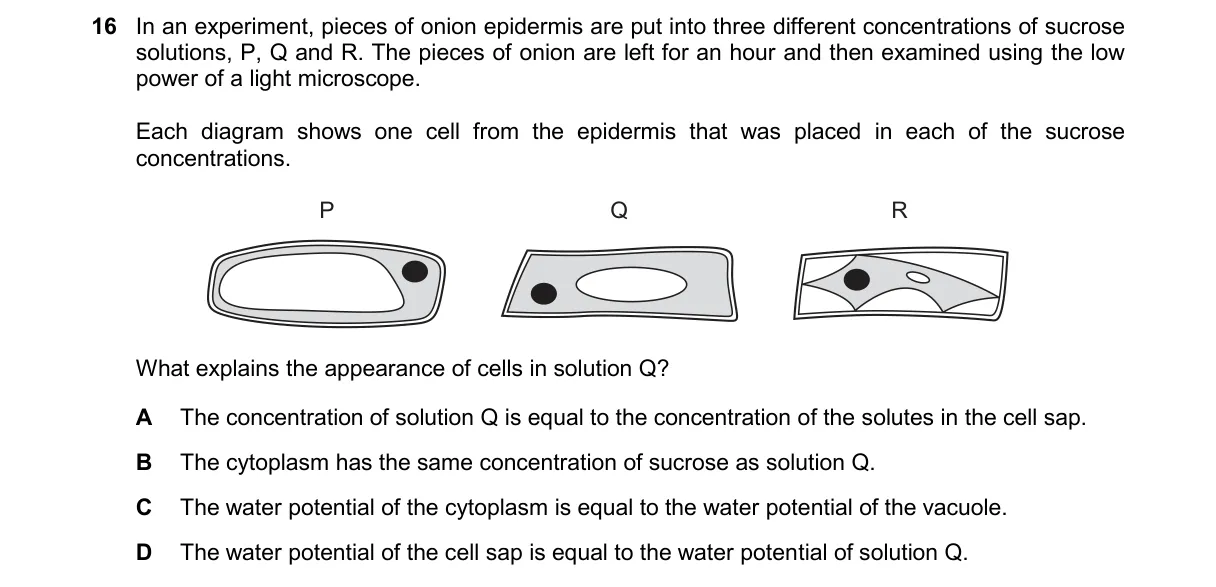
In an experiment, pieces of onion epidermis are put into different concentrations of sucrose solutions P, Q and R. The pieces of onion are left for an hour then examined using low power of light microscopes. Each diagram shows one cell from the epidermis that was placed in each sucrose concentrations. P Q R [diagrams] What explains the appearance of cells in solution Q?
Answer choices
- AThe concentration of solution Q is equal to the concentration of solutes in the cell.
- BThe cytoplasm has the same concentration as solution Q.
- CThe water potential of the cytoplasm is equal to the water potential of solution Q.
- DThe water potential of the cell is equal to the water potential of solution Q.
Explanation
Osmosis equilibrium in isotonic solution
Steps:
- Observe cell appearance in Q: unchanged, indicating no net water gain or loss.
- Recall osmosis: water moves across membrane from high to low water potential until equilibrium.
- Compare to P and R: P shows turgid cells (hypotonic, water enters); R shows plasmolysis (hypertonic, water exits).
- Conclude Q is isotonic, where water potentials balance, preventing change.
Why D is correct:
- Water potential equality (ψ_cell = ψ_solution) means no net osmosis, as water moves only down gradients (ψ = ψ_s + ψ_p).
Why the others are wrong:
- A: Solute concentration equality doesn't account for pressure potential in water potential.
- B: Cytoplasm concentration ignores vacuole, the main solute compartment in plant cells.
- C: Cytoplasm water potential differs from whole cell's, which includes vacuole and wall pressure.
Final answer: D
Topic: Movement into and out of cells
Practice more A Levels Biology (9700) questions on mMCQ.me