A Levels Biology (9700)•9700/12/O/N/24
A Levels Biology (9700) — 9700/12/O/N/24, Question 13
What can be concluded from information about allopurinol prevents the formation of uric acid?
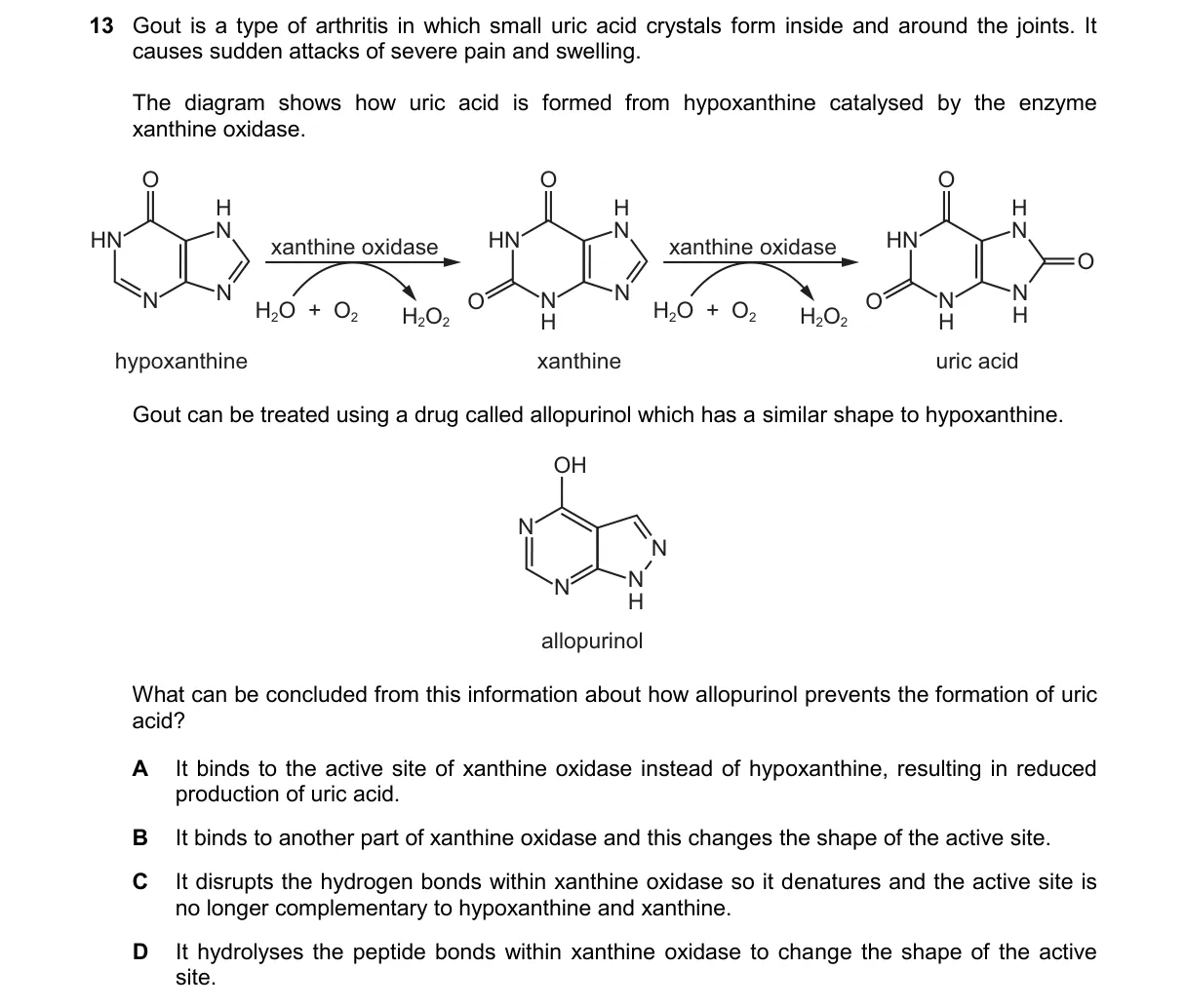
Answer choices
- AIt binds to the active site of xanthine oxidase instead of hypoxanthine, resulting in reduced production of uric acid.
- BIt binds to another part of xanthine oxidase and this changes the shape of the active site.
- CIt disrupts the hydrogen bonds between hypoxanthine and xanthine oxidase so features and the active site
- DIt hydrolyses the peptide bonds within xanthine oxidase to change the shape of the active site.
Explanation
Allopurinol as a competitive inhibitor of xanthine oxidase
Steps:
- Recall that allopurinol treats gout by inhibiting xanthine oxidase, the enzyme converting hypoxanthine to xanthine and then uric acid.
- Identify the mechanism: allopurinol structurally mimics hypoxanthine, binding to the enzyme's active site.
- Compare choices to competitive inhibition, where the inhibitor competes directly with substrate for the active site.
- Select the option matching this binding and reduced uric acid production.
Why A is correct:
- Competitive inhibition definition: inhibitor binds active site, blocking substrate (hypoxanthine) access and halting uric acid formation.
Why the others are wrong:
- B: Describes non-competitive inhibition, not allopurinol's mechanism.
- C: No evidence of hydrogen bond disruption; sentence is incomplete and inaccurate.
- D: Hydrolysis would irreversibly destroy enzyme, unlike allopurinol's reversible action.
Final answer: A
Topic: Mode of action of enzymes
Practice more A Levels Biology (9700) questions on mMCQ.me