A Levels Biology (9700)•9700/12/O/N/24
A Levels Biology (9700) — 9700/12/O/N/24, Question 10
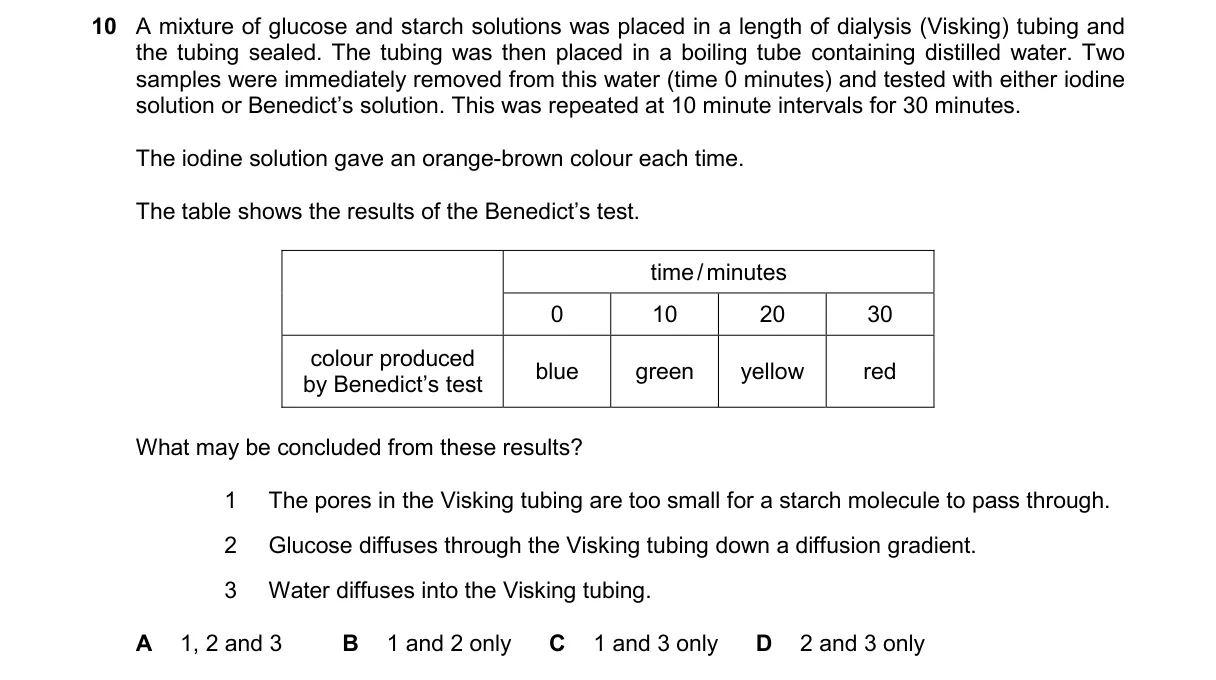
A mixture of glucose and starch solutions was placed in a length of dialysis (Visking) tubing and the tubing sealed. The tubing was then placed in a boiling tube containing distilled water. Iodine solution Benedict's test was repeated at 10 minute intervals for 30 minutes. Iodine solution gave an orange-brown colour each time. The table shows the results of the Benedict's test: time/minutes 0 10 20 30 colour produced by Benedict's test blue green yellow red What may be concluded from these results? 1 The pores in the Visking tubing are too small for a starch molecule to pass through. 2 Glucose diffuses through the Visking tubing down a concentration gradient. 3 Water diffuses into the Visking tubing.
Answer choices
- A1, 2 and 3
- B1 and 2 only
- C1 and 3 only
- D2 and 3 only
Explanation
Diffusion selectivity in dialysis tubing
Steps:
- Iodine test remains orange-brown, indicating starch stays inside tubing as it cannot pass through pores.
- Benedict's test changes from blue to red over time, showing glucose (reducing sugar) diffuses out into water.
- No evidence of water movement, such as volume change in tubing, to support osmosis into it.
- Thus, statements 1 and 2 are supported, but 3 lacks direct observation.
Why B is correct:
- Benedict's test detects reducing sugars like glucose; color progression confirms diffusion down concentration gradient per Fick's law.
Why the others are wrong:
- A includes unsupported water diffusion.
- C omits confirmed glucose diffusion.
- D excludes valid starch retention by pores.
Final answer: B
Topic: Movement into and out of cells
Practice more A Levels Biology (9700) questions on mMCQ.me