A Levels Biology (9700)•9700/11/O/N/24
A Levels Biology (9700) — 9700/11/O/N/24, Question 9
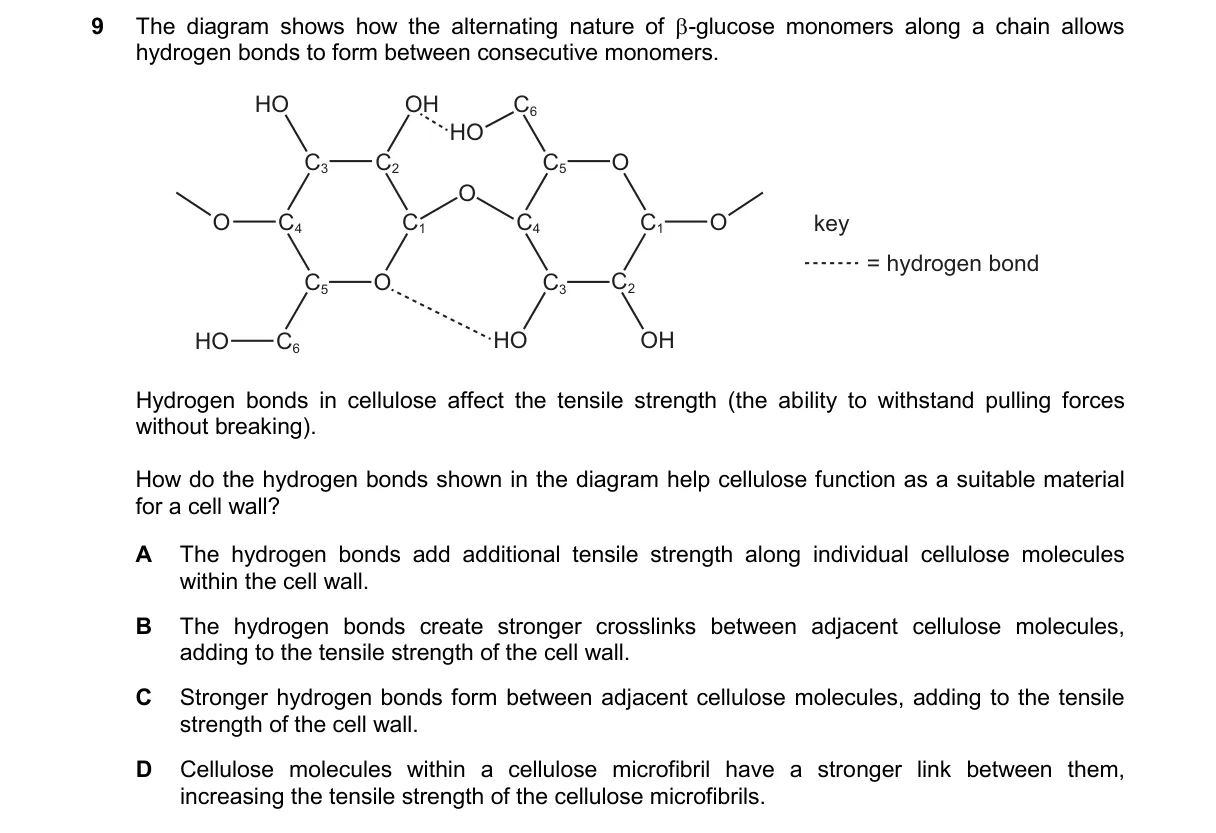
The diagram shows how the alternating nature of β-glucose monomers along a chain allows hydrogen bonds to form between adjacent chains without breaking. Hydrogen bonds in cellulose affect the tensile strength (the ability to withstand pulling forces without breaking). How do the hydrogen bonds shown in the diagram help cellulose function as a stable material for a cell wall?
Answer choices
- AThe hydrogen bonds add additional tensile strength along individual cellulose molecules
- Bwithin the cell wall. The hydrogen bonds create stronger crosslinks between adjacent cellulose molecules,
- Cadding the tensile strength of the cell wall.
- DCellulose molecules within a cellulose microfibril have a stronger link between them, increasing the tensile strength of the cellulose microfibrils.
Explanation
Hydrogen bonds link adjacent cellulose chains to boost overall tensile strength
Steps:
- Analyze diagram: alternating β-glucose enables H-bonds between adjacent chains.
- Recall cellulose composition: linear polymers form parallel bundles via these bonds.
- Define tensile strength: resistance to elongation under tension without fracture.
- Evaluate options: identify how inter-chain bonds reinforce pull resistance in cell walls.
Why A is correct:
- Tensile strength in polymers relies on both covalent backbone bonds and supplementary H-bonds; in cellulose, inter-chain H-bonds align and support individual molecules, distributing forces along their length per structural biochemistry principles.
Why the others are wrong:
- B: Focuses on crosslinks within cell wall but ignores that H-bonds primarily reinforce linear chain integrity, not just broader wall structure.
- C: Vague phrasing on adding strength lacks specificity to chain-level bonding shown in diagram.
- D: Describes microfibril-level effects, but diagram emphasizes bonds between basic adjacent chains, not bundled microfibrils.
Final answer: A
Topic: Carbohydrates and lipids
Practice more A Levels Biology (9700) questions on mMCQ.me