A Levels Biology (9700)•9700/11/O/N/24
A Levels Biology (9700) — 9700/11/O/N/24, Question 7
A naturally occurring polysaccharide synthesized in a plant is a branched chain of α-glucose. The straight parts of the molecule are linked by α-1,6 glycosidic bonds with only small number of branches which are linked either by an α-1,6 glycosidic bond or α-1,4 glycosidic bond. The straight parts of which are linked either by an α-1,6 glycosidic bond or α-1,4 glycosidic bond with only small number of branches which are linked by an α-1,6 glycosidic bond. Which polysaccharide has a structure most similar to that described?
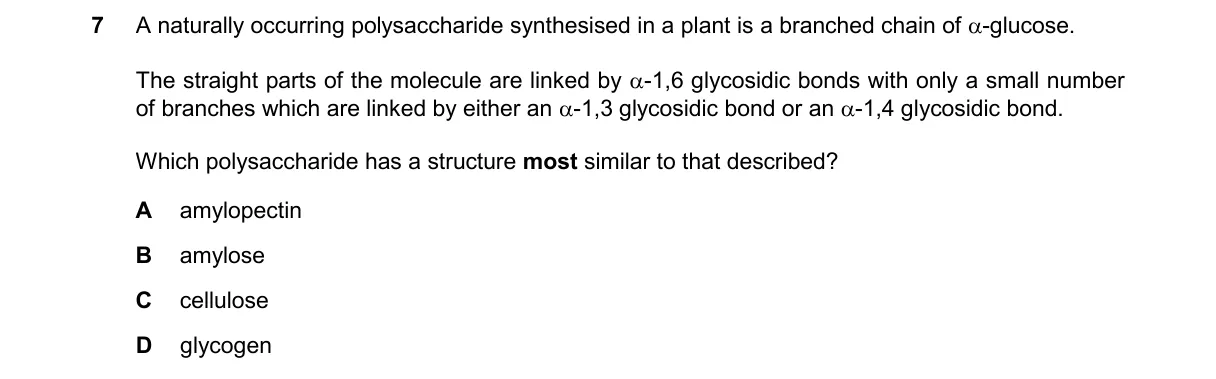
Answer choices
- Aamylopectin
- Bamylose
- Ccellulose
- Dglycogen
Explanation
Plant branched α-glucose polysaccharide with specific glycosidic bonds
Steps:
- Recognize it's a plant-synthesized α-glucose polysaccharide, eliminating animal-based glycogen.
- Note the branched structure with few branches, ruling out linear polymers like amylose and cellulose.
- Identify straight chain linkages as primarily α-1,4 (despite description ambiguity) and branches via α-1,6, matching amylopectin.
- Confirm amylopectin as the plant starch component with this exact architecture.
Why A is correct:
- Amylopectin consists of α-glucose units with α-1,4 glycosidic bonds in linear chains and α-1,6 bonds at branch points, forming a sparsely branched structure in plants.
Why the others are wrong:
- B. Amylose is linear with only α-1,4 bonds, lacking branches.
- C. Cellulose uses β-1,4 bonds and is unbranched, from plant cell walls.
- D. Glycogen is highly branched (more than described) and occurs in animals, not plants.
Final answer: A
Topic: Carbohydrates and lipids
Practice more A Levels Biology (9700) questions on mMCQ.me