A Levels Biology (9700)•9700/11/O/N/24
A Levels Biology (9700) — 9700/11/O/N/24, Question 33
The pumping action of the heart creates hydrostatic pressure in the blood. The table shows the hydrostatic pressure in a blood capillary. arterial end 4.2 kPa, venous end 1.7 kPa. About 90% of the tissue fluid which surrounds a capillary is returned to the blood at the venous end. How is this achieved?
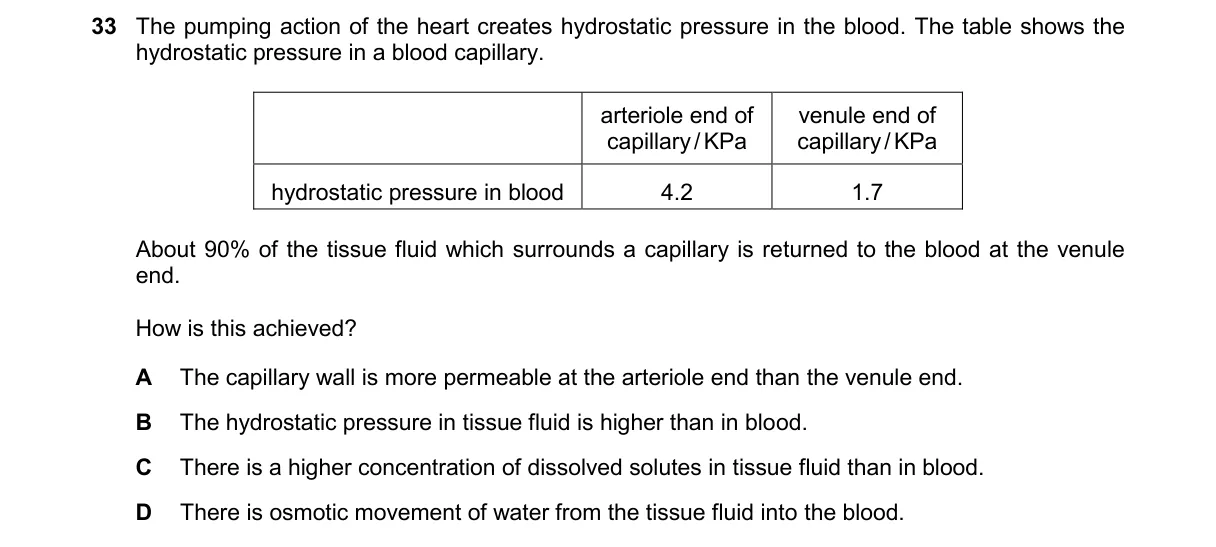
Answer choices
- AThe capillary wall is more permeable at the arterial end than at the venous end.
- BThe hydrostatic pressure in tissue fluid is higher than in blood at the venous end.
- CThere is a higher concentration of dissolved solutes in tissue fluid than in blood.
- DThere is osmotic movement of water from the tissue fluid into the blood.
Explanation
Osmosis enables fluid reabsorption at the venous end Steps:
- Hydrostatic pressure drops from 4.2 kPa at the arterial end to 1.7 kPa at the venous end, reducing outward force.
- Blood plasma proteins create colloid osmotic pressure (about 3.3 kPa), constant along the capillary.
- At the arterial end, hydrostatic pressure exceeds osmotic pressure, causing net filtration out.
- At the venous end, osmotic pressure exceeds hydrostatic pressure, causing net water movement into the blood.
Why D is correct:
- Osmosis is the diffusion of water across a semipermeable membrane from low to high solute concentration, driven here by higher plasma protein concentration pulling water back per Starling's hypothesis.
Why the others are wrong:
- A: Capillary permeability is uniform; pressure gradient, not permeability, controls direction.
- B: Tissue fluid hydrostatic pressure is near zero, lower than blood's 1.7 kPa, favoring inflow.
- C: Plasma has higher solute concentration (proteins) than tissue fluid, driving osmosis inward.
Final answer: D
Topic: The circulatory system
Practice more A Levels Biology (9700) questions on mMCQ.me