A Levels Biology (9700)•9700/11/O/N/24
A Levels Biology (9700) — 9700/11/O/N/24, Question 3
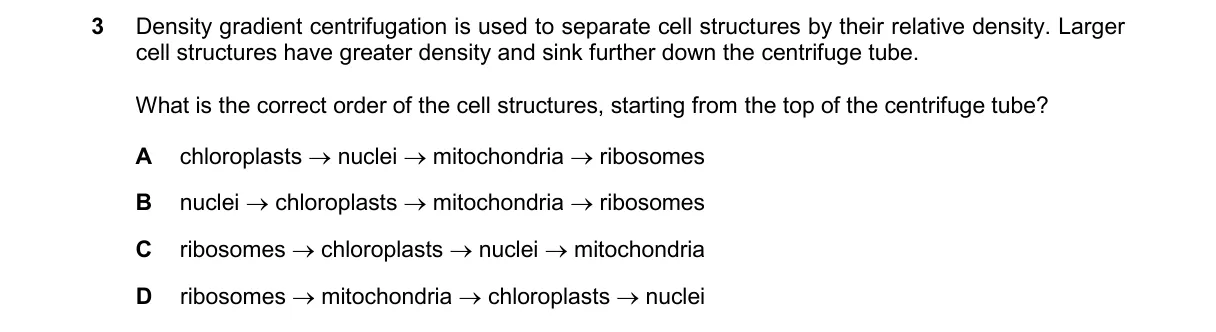
Density gradient centrifugation is used to separate structures by their relative density. Larger structures have greater density and sink further down the centrifuge tube. What is the order of the cell structures, starting from the top of the centrifuge tube?
Answer choices
- Achloroplasts → nuclei → mitochondria → ribosomes
- Bnuclei → chloroplasts → mitochondria → ribosomes
- Cribosomes → chloroplasts → nuclei → mitochondria
- Dribosomes → mitochondria → chloroplasts → nuclei
Explanation
Separation by increasing density in centrifugation
Steps:
- Least dense structures (smallest) remain at the top of the tube.
- Ribosomes are the smallest and least dense, so they band highest.
- Mitochondria are next in density, sinking below ribosomes.
- Chloroplasts have higher density than mitochondria, banding lower.
- Nuclei are the largest and densest, settling at the bottom.
Why D is correct:
- It lists structures in order of increasing density, from ribosomes (lowest) to nuclei (highest), per the principle that larger structures have greater density and sink further.
Why the others are wrong:
- A: Starts with chloroplasts, which are denser than ribosomes and mitochondria.
- B: Begins with nuclei, the densest structure, which should be at the bottom.
- C: Places chloroplasts before nuclei and mitochondria, inverting their relative densities.
Final answer: D
Topic: Cells as the basic units of living organisms
Practice more A Levels Biology (9700) questions on mMCQ.me