A Levels Biology (9700)•9700/11/O/N/24
A Levels Biology (9700) — 9700/11/O/N/24, Question 28
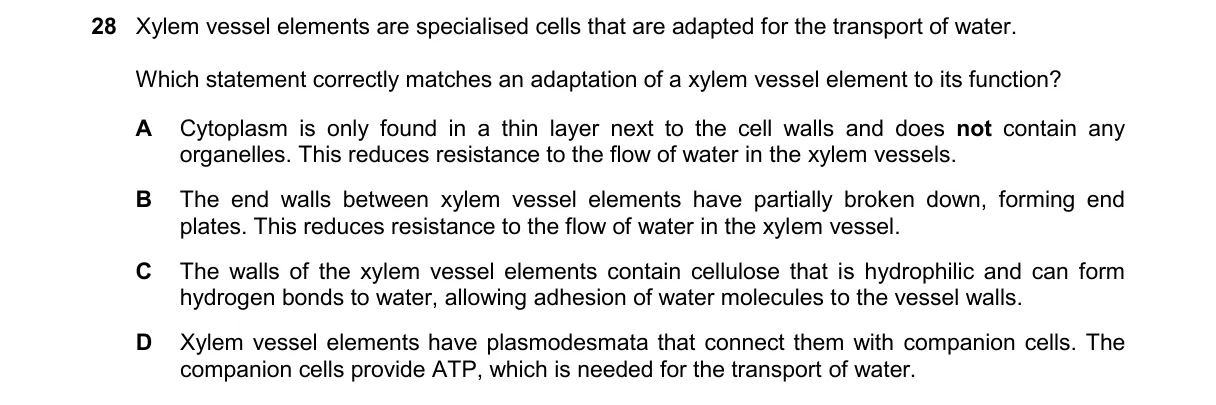
Xylem vessel elements are specialised cells that are adapted for the transport of water. Which statement is correct in adaptation of xylem vessel element to its function?
Answer choices
- ACytoplasm is only found in a thin layer next to the xylem walls and does not contain organelles.
- BThe end walls have been removed. This reduces resistance to the flow of water in the xylem vessels.
- CThe walls of the xylem vessel elements contain cellulose which is hydrophilic and can form hydrogen bonds with water molecules.
- DXylem vessel elements have plasmodesmata that connect them with companion cells. The companion cells provide ATP, which is needed for the transport of water.
Explanation
Xylem Vessel Adaptations for Efficient Water Transport
Steps:
- Identify key features of xylem vessels: dead, hollow cells with lignified walls for unidirectional water flow via transpiration pull.
- Evaluate options for structural adaptations that minimize resistance and maximize water adhesion.
- Eliminate inaccuracies about living cell features or incorrect associations.
- Confirm the option aligning with hydrophilic properties for capillary action.
Why C is correct:
- Cellulose in walls is hydrophilic, forming hydrogen bonds with water to enable adhesion and capillary rise, per principles of cohesion-tension theory.
Why the others are wrong:
- A: Xylem vessels are dead cells lacking cytoplasm and organelles entirely.
- B: End walls are perforated or absent, but this forms continuous tubes; resistance reduction is due to width and smoothness, not just end walls.
- D: Xylem vessels lack plasmodesmata and companion cells, which are phloem features for active transport.
Final answer: C
Topic: Structure of transport tissues
Practice more A Levels Biology (9700) questions on mMCQ.me