A Levels Biology (9700)•9700/11/O/N/24
A Levels Biology (9700) — 9700/11/O/N/24, Question 26
How many hydrogen bonds form when adenine and cytosine each bind to their complementary bases?
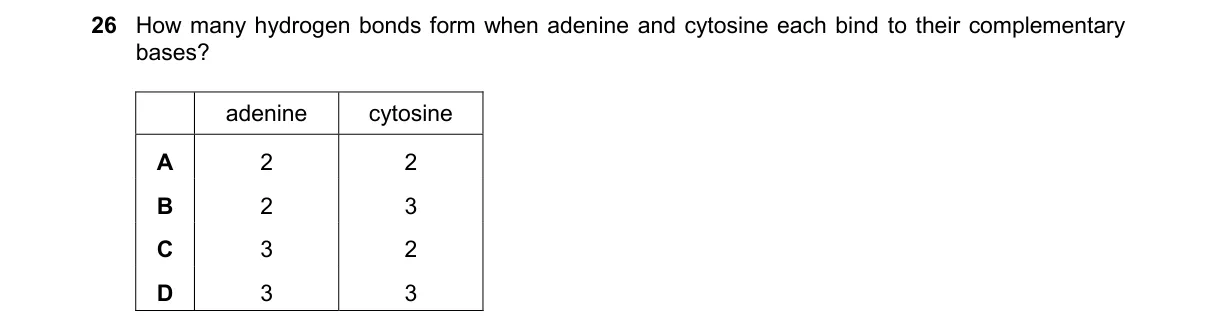
Answer choices
- Aadenine 2, cytosine 2
- Badenine 2, cytosine 3
- Cadenine 3, cytosine 2
- Dadenine 3, cytosine 3
Explanation
DNA Base Pairing Hydrogen Bonds
Steps:
- Adenine (A) complements thymine (T) in DNA.
- A-T pairing involves two hydrogen bonds between their nitrogen and oxygen atoms.
- Cytosine (C) complements guanine (G) in DNA.
- C-G pairing involves three hydrogen bonds between their nitrogen and oxygen/amino groups.
Why B is correct:
- DNA base pairing rules specify A-T forms 2 hydrogen bonds and C-G forms 3, as defined by Watson-Crick model.
Why the others are wrong:
- A: Cytosine-Guanine forms 3 bonds, not 2.
- C: Adenine-Thymine forms 2 bonds, not 3.
- D: Both pairings are miscounted; A-T is 2, not 3.
Final answer: B
Topic: Structure of nucleic acids and replication of DNA
Practice more A Levels Biology (9700) questions on mMCQ.me