A Levels Biology (9700)•9700/11/O/N/24
A Levels Biology (9700) — 9700/11/O/N/24, Question 23
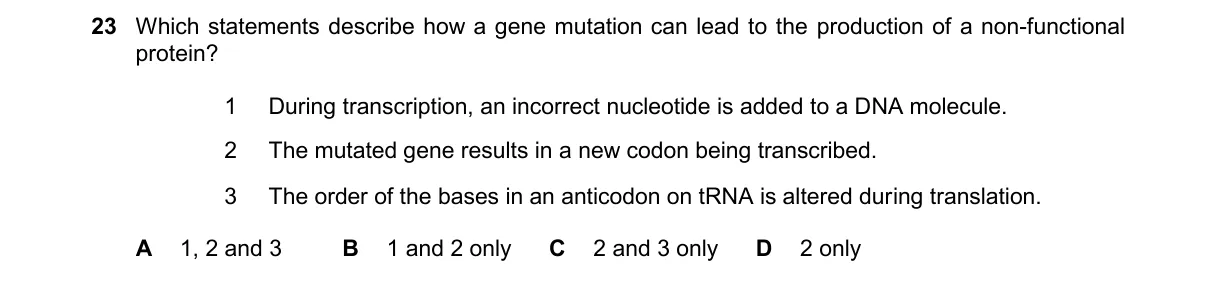
Which statements describe how a gene mutation can lead to the production of a non-functional protein? 1 During transcription, an incorrect nucleotide is added to DNA molecule. 2 The mutated gene bases in a codon tRNA is altered. 3 The order of bases anticodon RNA is altered during translation.
Answer choices
- A1, 2 and 3
- B1 and 2 only
- C2 and 3 only
- D2 only
Explanation
Gene Mutations Alter DNA Codons, Not Transcription or Translation Processes
Steps:
- Gene mutations change DNA base sequences, affecting mRNA codons during transcription and protein synthesis.
- Evaluate statement 1: Transcription copies DNA to mRNA; no nucleotides are added to DNA during this process—mutations occur via DNA replication errors.
- Evaluate statement 2: A mutation in the gene's DNA bases alters the corresponding mRNA codon, leading to incorrect tRNA binding and a faulty amino acid in the protein.
- Evaluate statement 3: Anticodons on tRNA are fixed and not altered during translation; mutations do not change tRNA sequences.
Why D is correct:
- Statement 2 aligns with the central dogma: DNA mutations change codon sequences in mRNA, causing mistranslation and non-functional proteins.
Why the others are wrong:
- A: Includes statements 1 and 3, which misplace mutation events outside DNA.
- B: Includes statement 1, which confuses transcription with DNA alteration.
- C: Includes statement 3, which incorrectly attributes changes to tRNA during translation.
Final answer: D
Topic: Protein synthesis
Practice more A Levels Biology (9700) questions on mMCQ.me