A Levels Biology (9700)•9700/11/O/N/24
A Levels Biology (9700) — 9700/11/O/N/24, Question 13
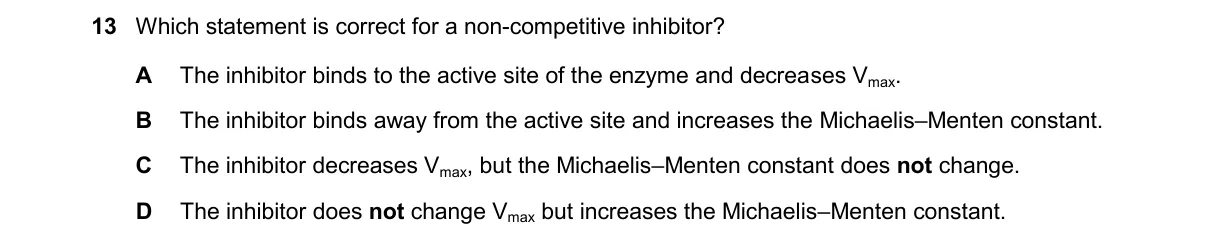
Which statement is correct for a non-competitive inhibitor?
Answer choices
- AThe inhibitor binds to the active site of the enzyme and decreases Vmax.
- BThe inhibitor binds away from the active site and increases Km.
- CThe inhibitor decreases Vmax, but the Michaelis-Menten constant does not change.
- DThe inhibitor does not change Vmax, but increases the Michaelis-Menten constant.
Explanation
Non-competitive inhibition reduces enzyme activity without affecting substrate binding
Steps:
- Define non-competitive inhibition: inhibitor binds to allosteric site, not active site.
- Recall kinetic effects: lowers Vmax by reducing active enzyme fraction, but Km unchanged as substrate affinity intact.
- Match to choices: identify option stating decreased Vmax with constant Km.
- Eliminate mismatches based on competitive inhibition traits.
Why C is correct:
- Non-competitive inhibitors decrease Vmax (fewer functional enzymes) while Km remains constant, per Michaelis-Menten kinetics where Km reflects substrate-enzyme affinity unaffected by allosteric binding.
Why the others are wrong:
- A: Binding to active site describes competitive inhibition, not non-competitive.
- B: Increasing Km indicates reduced substrate affinity, characteristic of competitive inhibition.
- D: Unchanged Vmax with increased Km fits competitive inhibition, not non-competitive.
Final answer: C
Topic: Mode of action of enzymes
Practice more A Levels Biology (9700) questions on mMCQ.me