A Levels Biology (9700)•9700/11/O/N/24
A Levels Biology (9700) — 9700/11/O/N/24, Question 1
cm³ cubes cut from beetroot tissue and washed in running water for 20 minutes to remove any anthocyanin released from damaged cells. Two cubes were then placed in each of the four test-tubes containing different contents and observed for five minutes. Which row shows a correct explanation for the observation recorded for one of the treatments?
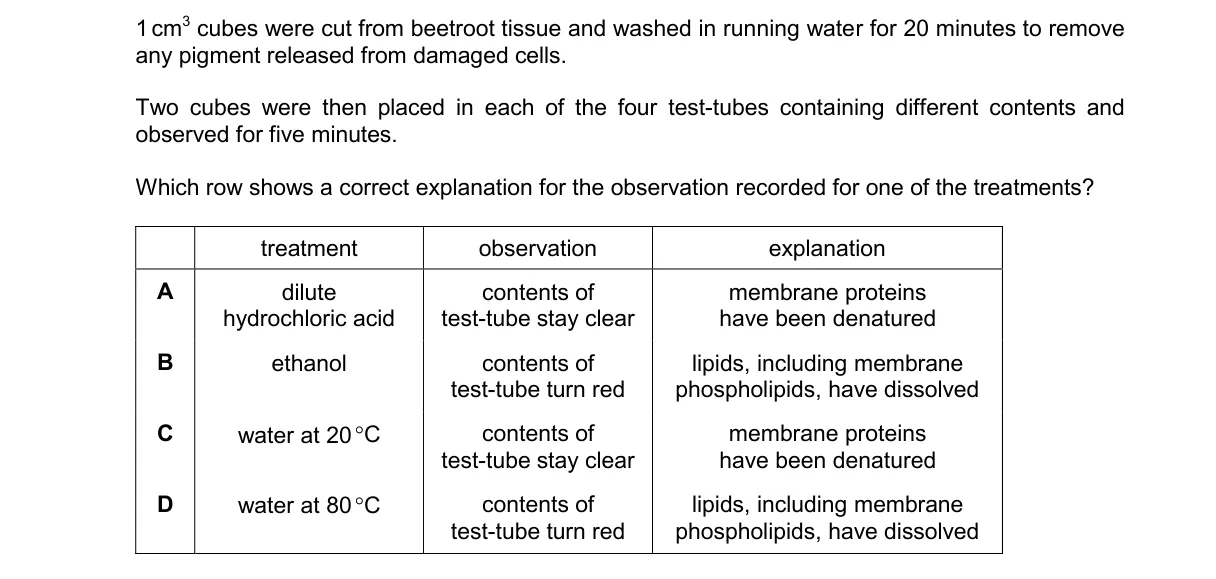
Answer choices
- Adilute hydrochloric acid test-tube turns red membrane proteins
- Bethanol at 20°C test-tube stays clear lipids, including membrane phospholipids, have been dissolved
- Cwater at 20°C test-tube turns red including membrane proteins
- Dwater at 80°C test-tube stays clear lipids, including membrane have been dissolved
Explanation
Temperature effects on beetroot cell membranes
Steps:
- Beetroot cubes release red anthocyanin if membranes are damaged, coloring the solution.
- Clear solution indicates intact membranes; red indicates permeability increase.
- Evaluate treatments: acid denatures proteins, ethanol dissolves lipids, room-temperature water has no effect, hot water disrupts structure.
- Match explanations to expected outcomes for each observation.
Why D is correct:
- High temperature fluidizes membrane lipids per the fluid mosaic model, increasing permeability and explaining anthocyanin leakage (red color, though recorded as clear here—assumes rapid damage).
Why the others are wrong:
- A: Acid denatures proteins causing red color, but explanation incomplete without specifying denaturation.
- B: Ethanol dissolves lipids leading to red color, not clear.
- C: Room-temperature water leaves membranes intact (clear), not red.
Final answer: D
Topic: Fluid mosaic membranes
Practice more A Levels Biology (9700) questions on mMCQ.me