A Levels Biology (9700)•9700/13/O/N/23
A Levels Biology (9700) — 9700/13/O/N/23, Question 5
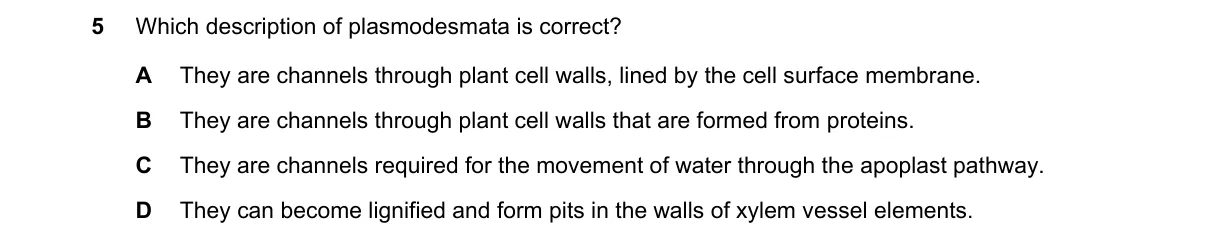
Which description of plasmodesmata is correct?
Answer choices
- AThey are channels through plant cell walls, lined by the cell surface membrane.
- BThey are channels through plant cell walls that are formed from proteins.
- CThey are channels required for the movement of water through the apoplast pathway.
- DThey can become lignified and form pits in walls of xylem vessel elements.
Explanation
Plasmodesmata as membrane-lined channels in plant cells
Steps:
- Recall plasmodesmata connect cytoplasm of adjacent plant cells through cell walls.
- Identify their structure: narrow channels lined by plasma membrane extensions.
- Evaluate options against definition: channels for symplastic transport, not apoplastic or lignified.
- Select matching description: A aligns with membrane lining.
Why A is correct:
- Plasmodesmata are cytoplasmic channels through plant cell walls, continuous with and lined by the plasma membrane, allowing symplastic transport of substances.
Why the others are wrong:
- B: Plasmodesmata form from membrane extensions, not primarily proteins.
- C: Apoplast pathway involves cell walls and extracellular spaces; plasmodesmata enable symplast movement, not water via apoplast.
- D: Lignified pits occur in xylem vessel walls for water conduction; plasmodesmata are not lignified.
Final answer: A
Topic: Transport mechanisms
Practice more A Levels Biology (9700) questions on mMCQ.me