A Levels Biology (9700)•9700/13/O/N/23
A Levels Biology (9700) — 9700/13/O/N/23, Question 38
The diagram shows one way of testing the effect of an antibiotic on bacteria Petri dish with colonies of bacteria grown for 5 days Nutrient agar containing filter disc soaked in antibiotic diameter of zone measured every day for 5 days The table shows the results of testing five different types of bacteria. Zones of less than 1.0 mm show presence of resistant bacteria. type day 1 day 2 day 3 day 4 day 5 1 24.1 21.9 19.0 17.6 14.3 2 18.6 15.4 12.0 9.7 6.3 3 17.9 15.8 13.2 11.1 10.9 4 20.5 21.0 20.5 20.4 20.4 5 20.5 21.0 20.5 20.4 20.4 Which statement
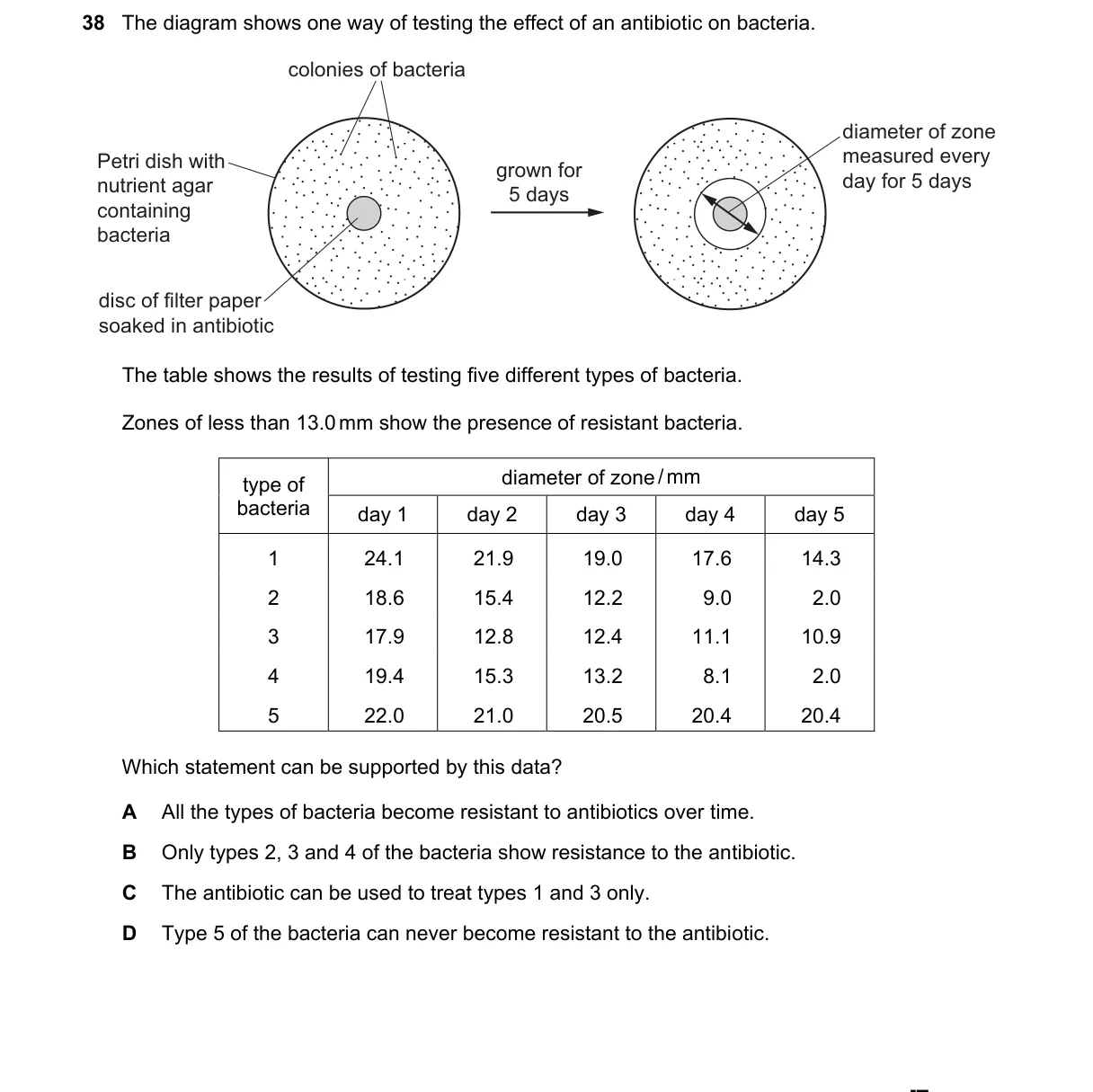
Answer choices
- AAll types of bacteria become resistant to this antibiotic over time.
- BOnly types 2, 3 and 4 of the bacteria show resistance to the antibiotic.
- CType 5 of the bacteria can be used to treat types 1 and 3 only.
- DType 5 of bacteria can never become resistant
Explanation
Bacterial resistance indicated by shrinking inhibition zones
Steps:
- Review zone diameter changes in the table over 5 days.
- Type 1 decreases from 24.1 mm to 14.3 mm, showing emerging resistant bacteria.
- Type 2 decreases from 18.6 mm to 6.3 mm, showing emerging resistant bacteria.
- Type 3 decreases from 17.9 mm to 10.9 mm, showing emerging resistant bacteria.
- Types 4 and 5 remain stable near 20 mm, showing no resistance development.
Why B is correct:
- Decreasing zones indicate resistant bacteria growing into the cleared area (per standard antibiotic sensitivity testing, where shrinking zones signal resistance emergence before reaching <1.0 mm threshold).
Why the others are wrong:
- A: Types 4 and 5 do not decrease, so not all become resistant.
- C: Bacteria types do not "treat" others; this misinterprets the experiment.
- D: Data shows type 5 remains sensitive over 5 days, but cannot confirm "never."
Final answer: B
Topic: Antibiotics
Practice more A Levels Biology (9700) questions on mMCQ.me