A Levels Biology (9700)•9700/13/O/N/23
A Levels Biology (9700) — 9700/13/O/N/23, Question 30
When a blood vessel is damaged it can result in problems in the body. Which row identifies the blood vessel that is not being distributed to organs that need it blood that is not returning to the heart and is the blood surges mean blood surges that relatively constant blood pressure is that
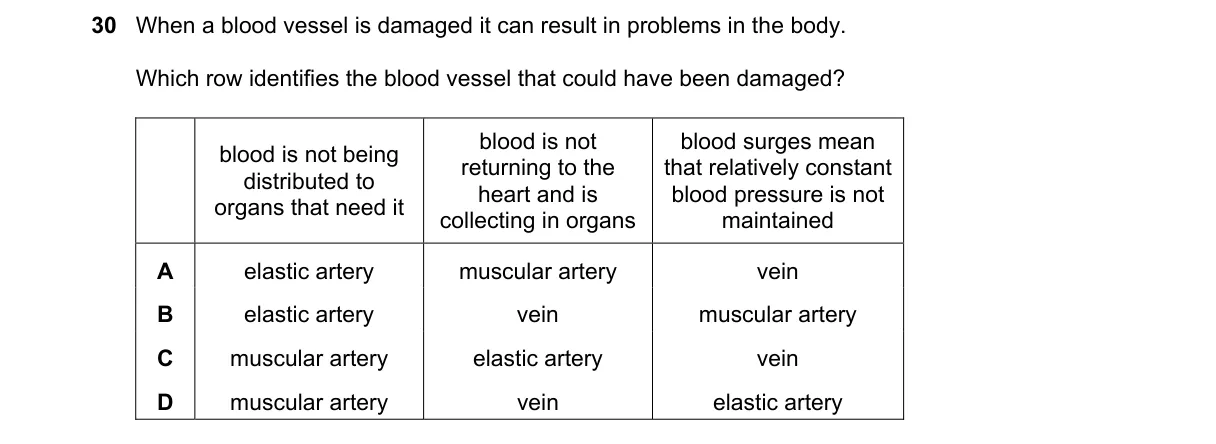
Answer choices
- Aelastic artery, muscular artery, vein
- Bmuscular artery, vein, elastic artery
- Celastic artery, vein, muscular artery
- Dmuscular artery, elastic artery, muscular artery
Explanation
Matching blood vessels to circulatory functions and damage effects
Steps:
- Identify vessel responsible for distributing blood to specific organs: muscular artery, via smooth muscle control.
- Identify vessel that absorbs blood surges from ventricular ejection: elastic artery, through elastic recoil.
- Identify vessel that helps maintain relatively constant blood pressure: muscular artery, by regulating peripheral resistance.
- Match sequence to options: muscular artery, elastic artery, muscular artery corresponds to D.
Why D is correct:
- Muscular arteries distribute blood and regulate pressure via vasoconstriction/dilation (Starling's law of capillaries ties to resistance control); elastic arteries dampen surges per their elastin content.
Why the others are wrong:
- A: Elastic artery first mismatches distribution role—elastic arteries conduct from heart, not target organs.
- B: Vein second mismatches surge handling—veins lack elasticity for pressure buffering.
- C: Vein second and muscular third swap surge and pressure roles—veins return blood passively, not regulate.
Final answer: D
Topic: The circulatory system
Practice more A Levels Biology (9700) questions on mMCQ.me