A Levels Biology (9700)•9700/13/O/N/23
A Levels Biology (9700) — 9700/13/O/N/23, Question 13
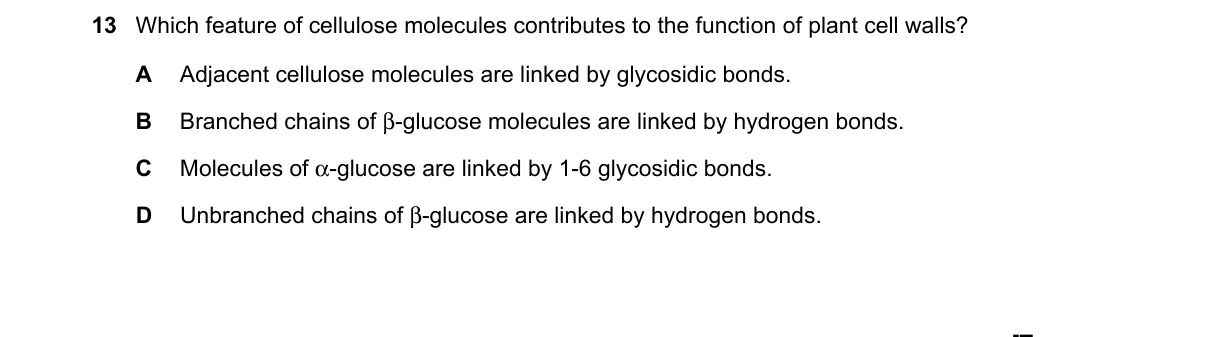
Which feature of cellulose molecules contributes to the function of plant cell walls?
Answer choices
- AAdjacent cellulose molecules are linked by glycosidic bonds
- BBranched chains of β-glucose are linked by hydrogen bonds
- CMolecules of β-glucose are linked by 1-4 glycosidic bonds
- DUnbranched chains of β-glucose linked hydrogen bonds
Explanation
Cellulose's hydrogen-bonded structure strengthens plant cell walls
Steps:
- Cellulose consists of β-glucose monomers forming linear polymers.
- β-Glucose units connect via 1-4 glycosidic bonds to create unbranched chains.
- These chains align and bond via hydrogen bonds, forming rigid microfibrils.
- Microfibrils provide tensile strength and support to cell walls.
Why D is correct:
- Hydrogen bonds between unbranched β-glucose chains create a network of parallel microfibrils, giving cell walls mechanical strength and rigidity as per polymer structure principles.
Why the others are wrong:
- A: Glycosidic bonds link glucose units within a single chain, not between adjacent cellulose molecules.
- B: Cellulose forms straight, unbranched chains, unlike branched structures in other polysaccharides like glycogen.
- C: 1-4 glycosidic bonds build individual chains but do not link chains together for structural reinforcement.
Final answer: D
Topic: Carbohydrates and lipids
Practice more A Levels Biology (9700) questions on mMCQ.me