A Levels Biology (9700)•9700/13/O/N/23
A Levels Biology (9700) — 9700/13/O/N/23, Question 11
Which statement about phospholipid molecules is correct?
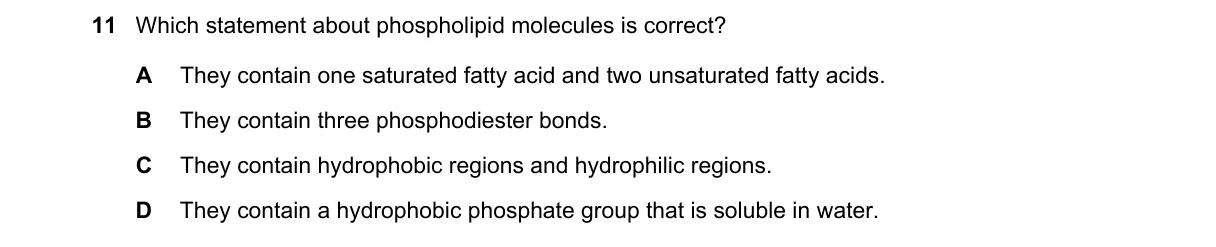
Answer choices
- AThey contain one saturated fatty acid and two unsaturated fatty acids.
- BThey contain three phosphate bonds and two saturated fatty acids.
- CThey contain hydrophobic regions and hydrophilic regions.
- DThey contain a hydrophobic phosphate group that is soluble in water.
Explanation
Phospholipids are amphipathic molecules
Steps:
- Recall that phospholipids form cell membranes and consist of a glycerol backbone, two fatty acid chains, and a phosphate group.
- Identify key properties: fatty acid chains are nonpolar (hydrophobic), while the phosphate head is polar (hydrophilic).
- Evaluate each option against this structure to find the accurate description.
- Confirm the option that matches the amphipathic nature essential for bilayer formation.
Why C is correct:
- Phospholipids are amphipathic, with hydrophobic tails (fatty acids) repelling water and hydrophilic heads (phosphate) attracting it, as defined by their molecular structure enabling membrane self-assembly.
Why the others are wrong:
- A: Phospholipids have two fatty acids, which can be saturated or unsaturated, not specifically one saturated and two unsaturated.
- B: They have one phosphate group with ester bonds, not three phosphate bonds, and fatty acids vary in saturation.
- D: The phosphate group is hydrophilic and water-soluble, not hydrophobic.
Final answer: C
Topic: Carbohydrates and lipids
Practice more A Levels Biology (9700) questions on mMCQ.me