A Levels Biology (9700)•9700/13/O/N/23
A Levels Biology (9700) — 9700/13/O/N/23, Question 10
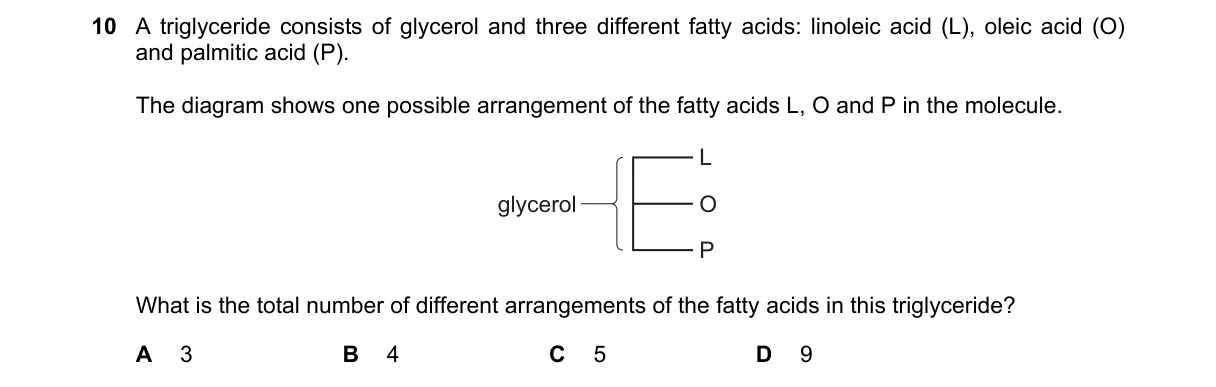
A triglyceride consists of glycerol and three different fatty acids: linoleic (L), oleic (O) and palmitic (P). The diagram shows one possible arrangement of the fatty acids L, O and P in the molecule. What is the total number of different arrangements of the fatty acids in this triglyceride?
Answer choices
- A3
- B4
- C5
- D9
Explanation
Symmetry in Glycerol Positions Limits Distinct Triglycerides
Steps:
- Glycerol has three hydroxyl groups: two equivalent primary (sn-1, sn-3) and one secondary (sn-2).
- With three different fatty acids (L, O, P), assign one to sn-2: 3 choices.
- Assign remaining two to sn-1 and sn-3: swapping them yields identical molecules due to symmetry.
- Total distinct arrangements: 3 (one for each choice in sn-2).
Why A is correct:
- The formula for stereospecific numbering (sn) in glycerol defines sn-1 and sn-3 as indistinguishable, reducing permutations from 6 to 3.
Why the others are wrong:
- B: Ignores symmetry, undercounts by treating all positions as distinct but not fully (would be 6 if no symmetry).
- C: No basis; possibly confuses with partial distinctions.
- D: Assumes all 3! = 6 permutations plus extras, overlooking glycerol's mirror plane.
Final answer: A
Topic: Carbohydrates and lipids
Practice more A Levels Biology (9700) questions on mMCQ.me