A Levels Biology (9700)•9700/12/O/N/23
A Levels Biology (9700) — 9700/12/O/N/23, Question 39
A patient with kidney failure can be given a kidney transplant. In a kidney transplant, a healthy kidney is taken from another person and put into the different body. Sometimes the donated kidney cells are killed by the patient's body. In this primary immune response, T-lymphocytes describe the next stages of the primary immune response. 1 Activated T-lymphocyte secretes cytokines. 2 B-lymphocytes differentiate into plasma cells and make antibodies. 3 B-lymphocytes bind to antigens on donor kidney cells and are activated. 4 T-killer cells release toxins that destroy the donor kidney cells. 5 T-killer cells differentiate into T-killer cells. Which correctly explains how donor kidney cells are killed?
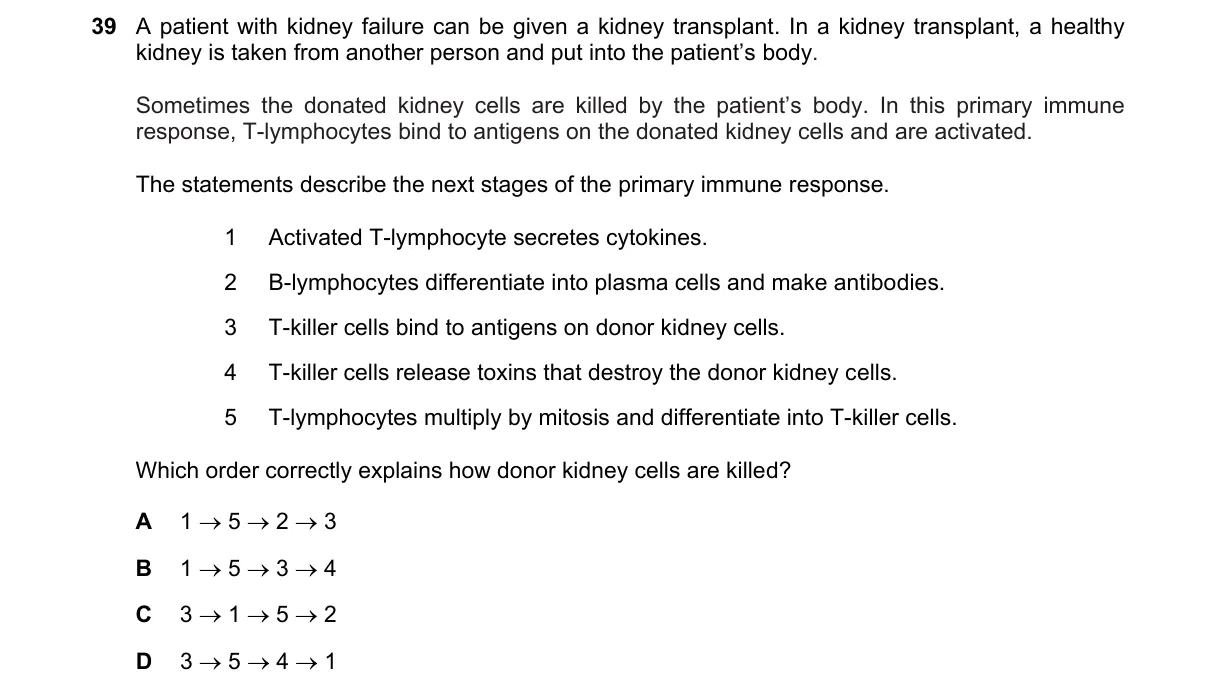
Answer choices
- A1→5→2→3
- B3→1→5→2
- C3→5→4→1
- D5→4→3→1
Explanation
Immune Response Sequence in Transplant Rejection
Steps:
- B-lymphocytes first bind to antigens on donor kidney cells, initiating activation (step 3).
- Activated T-lymphocytes then secrete cytokines to amplify the response and aid cell differentiation (step 1).
- Cytokines promote precursor T cells to differentiate into cytotoxic T-killer cells (step 5).
- Activated B-lymphocytes differentiate into plasma cells, producing antibodies that target and destroy donor cells via complement activation or opsonization (step 2).
Why B is correct:
- It follows the standard primary immune response pathway where antigen binding (3) triggers T-cell cytokine release (1) for helper signals, leading to T-killer differentiation (5) and B-cell antibody production (2) for targeted cell lysis.
Why the others are wrong:
- A starts with cytokine secretion (1) before antigen recognition, violating activation sequence.
- C places killing by T-killer cells (4) before cytokine secretion (1), but cytokines precede effector functions.
- D begins with T-killer differentiation (5) without prior antigen or T-cell activation.
Final answer: B
Topic: The immune system
Practice more A Levels Biology (9700) questions on mMCQ.me