A Levels Biology (9700)•9700/12/O/N/23
A Levels Biology (9700) — 9700/12/O/N/23, Question 37
Which conclusions can be made from these results?
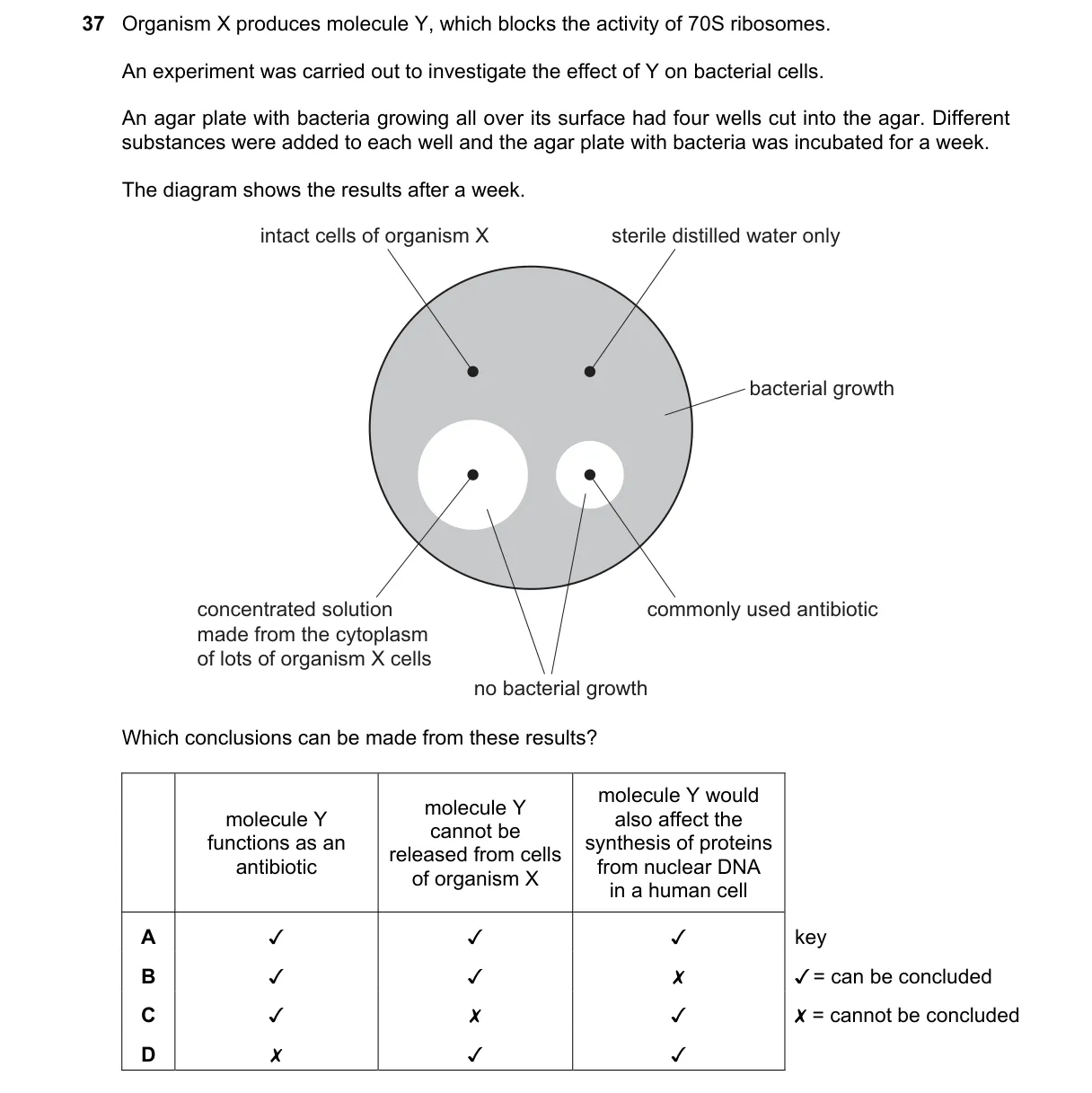
Answer choices
- Amolecule Y functions as an antibiotic (✓), molecule Y cannot be of organism X (✗), molecule Y would be synthesized from DNA in a human cell (✓)
- Bmolecule Y functions as an antibiotic (✓), molecule Y cannot be of organism X (X), molecule Y would be synthesized from DNA in a human cell (✓)
- Cmolecule Y functions as an antibiotic (X), molecule Y cannot be of organism X (✓), molecule Y would be synthesized from DNA in a human cell (X)
- Dmolecule Y functions as an antibiotic (X), molecule Y cannot be of organism X (X), molecule Y would be synthesized from DNA in a human cell (✓)
Explanation
Interpreting molecule Y's biological role from experimental data
Steps:
- Analyze inhibition: Molecule Y stops organism X growth, confirming antibiotic function (✓).
- Evaluate origin: Results show organism X produces Y without self-harm, so "cannot be of X" is invalid (X).
- Assess synthesis: Y is a protein, translated from mRNA derived from DNA, applicable to human cells (✓).
- Match symbols: Only B correctly assigns ✓, X, ✓ to the statements.
Why B is correct:
- B aligns with central dogma of molecular biology: Proteins like Y are synthesized via DNA transcription to RNA and translation in eukaryotes including humans.
Why the others are wrong:
- A incorrectly marks second statement as ✗, ignoring X's production of Y.
- C wrongly denies antibiotic function and human synthesis.
- D mislabels antibiotic role and X origin.
Final answer: B
Topic: Antibiotics
Practice more A Levels Biology (9700) questions on mMCQ.me