A Levels Biology (9700)•9700/12/O/N/23
A Levels Biology (9700) — 9700/12/O/N/23, Question 27
When sucrose is loaded into the phloem it has to travel from mesophyll cells to companion cell. Which row shows the relative concentrations of sucrose in each type of cell in order for this process to take place?
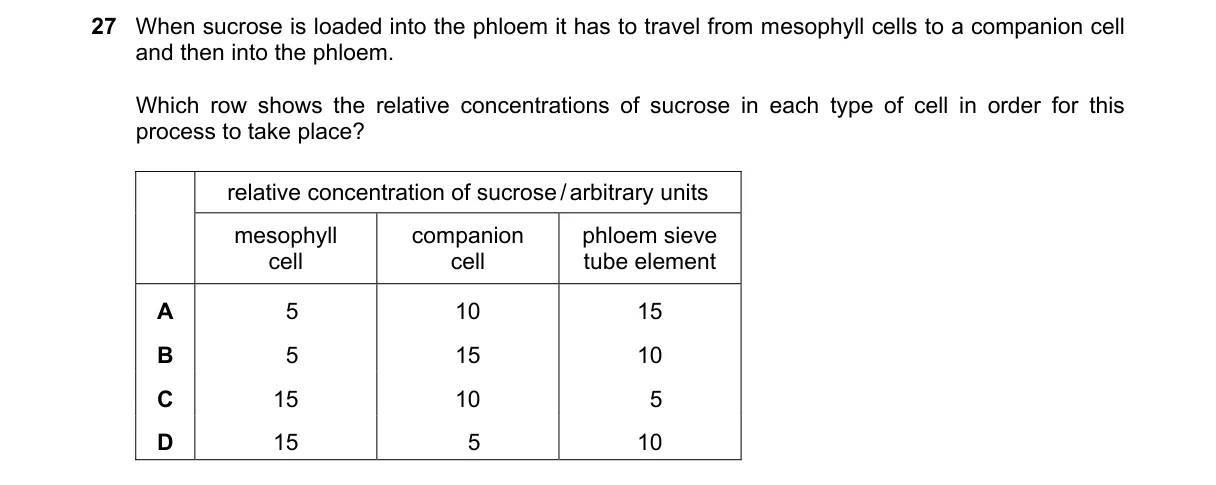
Answer choices
- Amesophyll 5, companion 10, phloem sieve 15
- Bmesophyll 5, companion 15, phloem sieve 10
- Cmesophyll 15, companion 5, phloem sieve 10
- Dmesophyll 15, companion 10, phloem sieve 5
Explanation
Active phloem loading via concentration gradient
Steps:
- Sucrose forms in mesophyll cells at lower concentration.
- Active transport loads it into companion cells, raising concentration for osmotic pull.
- High companion concentration drives passive diffusion to sieve tubes.
- Sieve concentration stays high but lower than companion to maintain flow.
Why B is correct:
- B establishes an increasing gradient from mesophyll (5) to companion (15) for active loading, per pressure-flow hypothesis.
Why the others are wrong:
- A: Sieve (15) exceeds companion (10), requiring active transport where passive diffusion occurs.
- C: Mesophyll (15) exceeds companion (5), reversing gradient and blocking loading.
- D: Mesophyll (15) exceeds companion (10), causing sucrose leakage from phloem.
Final answer: B
Topic: Transport mechanisms
Practice more A Levels Biology (9700) questions on mMCQ.me