A Levels Biology (9700)•9700/12/O/N/23
A Levels Biology (9700) — 9700/12/O/N/23, Question 16
Plant cells were left 50 min in three different sugar solutions, 10%, 5% and 1%. Water potential in the cytoplasm of the three cells was the same at the start of the experiment. The diagrams show the appearance of the cells after 50 min, using a light microscope. Which conclusion is correct?
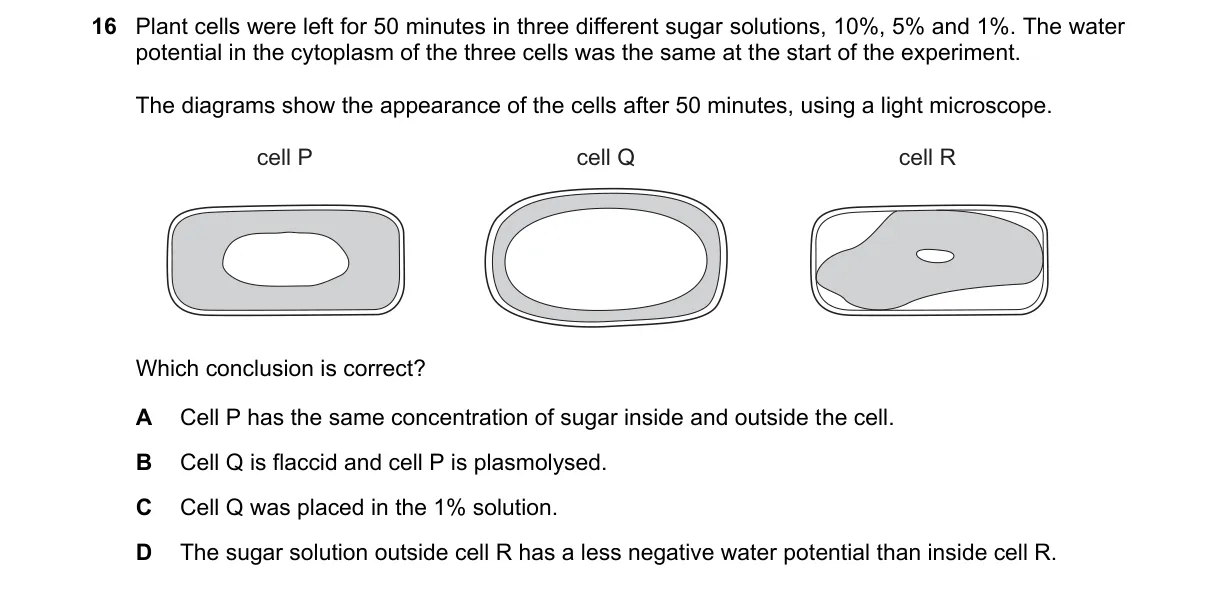
Answer choices
- ACell P has the same concentration of sugar inside and outside the cell.
- BCell Q is flaccid and the 1% solution.
- CCell Q was placed in the 1% solution.
- DThe sugar solution outside R has a less negative water potential than inside R
Explanation
Osmosis drives water movement based on external sugar concentration
Steps:
- All cells have identical initial cytoplasmic water potential, so internal solute concentration is the same.
- External solutions have decreasing sugar concentrations (10% > 5% > 1%), creating a gradient of water potentials (ψ_{10%} < ψ_{5%} < ψ_{1%}, more negative to less negative).
- In 1% solution (highest ψ outside), water enters the cell, causing turgidity.
- Cell Q appears turgid, matching the hypotonic 1% solution.
Why C is correct:
- Turgid cells result from water influx in hypotonic solutions (external ψ > internal ψ), defining the 1% solution as hypotonic relative to cell cytoplasm.
Why the others are wrong:
- A: Equal concentrations imply isotonic conditions (no net water movement), but cell P likely shows shrinkage, indicating hypertonic external solution.
- B: Flaccid cells indicate isotonic conditions (ψ outside = ψ inside), not hypotonic 1% solution.
- D: Plasmolysis in R shows water efflux, so external ψ is more negative (lower) than internal ψ.
Final answer: C
Topic: Movement into and out of cells
Practice more A Levels Biology (9700) questions on mMCQ.me