A Levels Biology (9700)•9700/12/O/N/23
A Levels Biology (9700) — 9700/12/O/N/23, Question 13
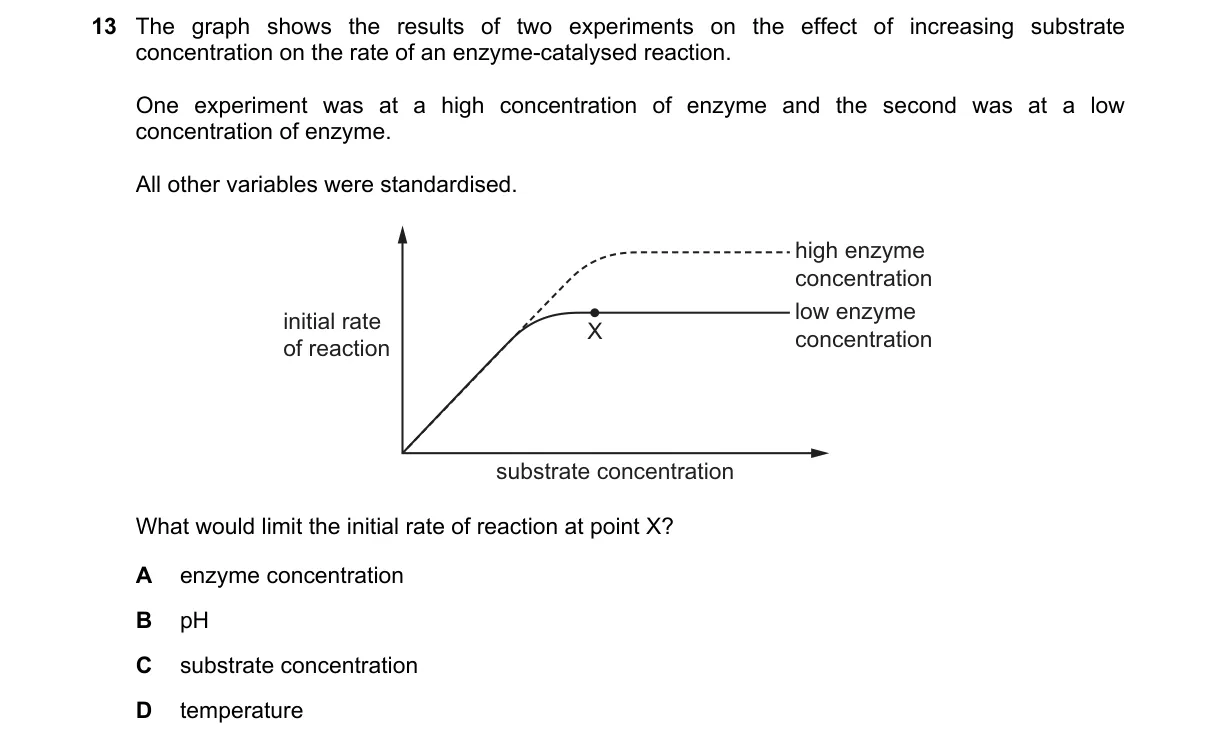
The graph shows results of two experiments on the effect of increasing substrate concentration on the rate of an enzyme-catalysed reaction. One experiment was at a high concentration of enzyme and the second was at a low concentration of enzyme. All other variables were standardised. What would limit the initial rate of reaction at point X?
Answer choices
- Aenzyme concentration
- BpH
- Ctemperature
- Dsubstrate concentration
Explanation
Enzyme concentration limits initial rate at low substrate levels
Steps:
- Enzyme kinetics follow Michaelis-Menten model, where initial rate depends on enzyme [E] and substrate [S] concentrations.
- At low [S] (<< Km), rate v ≈ (Vmax/Km)[S], with Vmax proportional to [E].
- Graph shows higher [E] yields steeper initial slope, indicating rate scales with [E] at same [S].
- Point X on low-[E] curve reflects unsaturated conditions, so low [E] caps the rate despite increasing [S].
Why A is correct:
- Vmax = kcat[E_total]; low [E] directly reduces maximum achievable rate, limiting initial velocity at non-saturating [S].
Why the others are wrong:
- B: pH standardized across experiments, so not a variable factor.
- C: Temperature standardized, eliminating it as limiter.
- D: [S] increasing drives rate up, but curves diverge due to [E], not [S] differences.
Final answer: A