A Levels Biology (9700)•9700/11/O/N/23
A Levels Biology (9700) — 9700/11/O/N/23, Question 40
Which statement explains how a vaccination programme can control the spread of an infectious disease in a population?
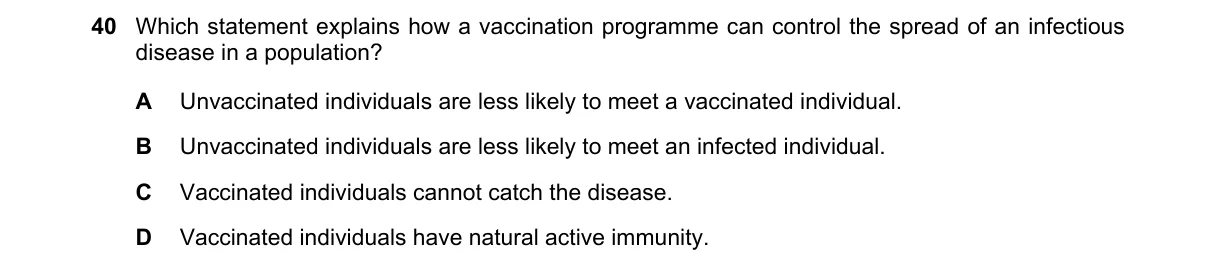
Answer choices
- AUnvaccinated individuals are less likely to meet a vaccinated individual.
- BVaccinated individuals cannot catch the disease.
- CUnvaccinated individuals cannot catch the disease.
- DVaccinated individuals have natural active immunity.
Explanation
Herd Immunity Through Vaccination
Steps:
- Identify the goal: Control disease spread by reducing transmission in the population.
- Recall vaccination effect: Vaccines induce immunity, preventing infection in recipients.
- Link to population control: High vaccination rates limit susceptible hosts, breaking transmission chains.
- Evaluate options: Select the one explaining reduced catching and spreading by vaccinated individuals.
Why B is correct:
- Vaccinations confer active immunity, preventing vaccinated people from catching and transmitting the disease, which reduces overall spread per herd immunity principles.
Why the others are wrong:
- A: Meeting patterns are unrelated to vaccination's biological protection against infection.
- C: Unvaccinated remain susceptible and can catch the disease, enabling spread.
- D: Vaccinations provide artificial active immunity, not natural (from prior infection).
Final answer: B
Topic: Antibodies and vaccination
Practice more A Levels Biology (9700) questions on mMCQ.me