A Levels Biology (9700)•9700/11/O/N/23
A Levels Biology (9700) — 9700/11/O/N/23, Question 35
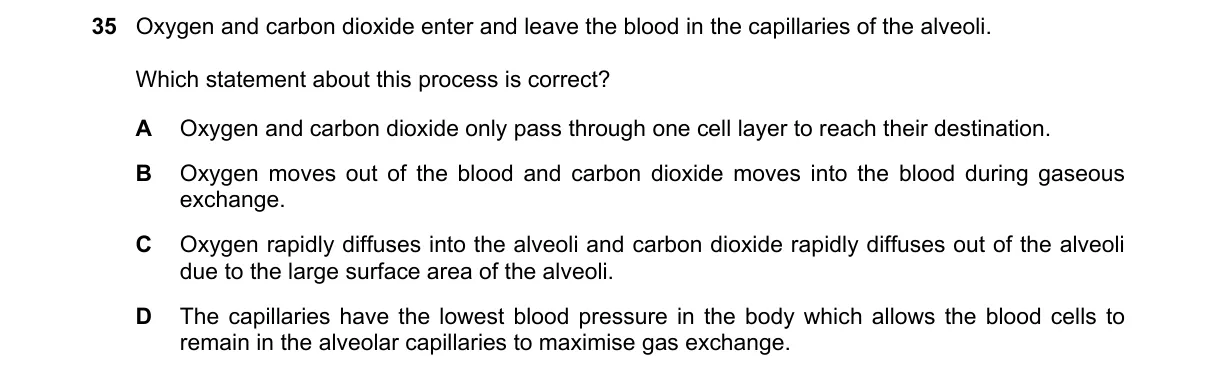
Oxygen and carbon dioxide enter and leave the blood in the capillaries of the alveoli. Which statement about this process is correct?
Answer choices
- AOxygen moves out of the blood and carbon dioxide moves into the blood during gaseous exchange.
- BOxygen and carbon dioxide only pass through one cell layer to reach their destination.
- COxygen rapidly diffuses into the alveoli and carbon dioxide rapidly diffuses out of the alveoli due to the large surface area.
- Dlowest blood pressure in the capillaries which allows the blood cells to remain in the alveolar capillaries to maximise gas exchange.
Explanation
Gas Exchange in Alveoli
Steps:
- Gas exchange occurs via diffusion across the thin respiratory membrane between alveolar air and blood.
- Oxygen moves from alveoli (high concentration) into blood (low), while CO2 moves from blood (high) to alveoli (low).
- The membrane is extremely thin, consisting of alveolar epithelial cells and capillary endothelial cells, effectively one cell layer.
- Evaluate choices: A reverses directions; C reverses directions and misattributes cause; D misstates pressure role; B accurately describes the barrier.
Why the correct option is correct:
- B aligns with the definition of the respiratory membrane as a single, thin cell layer (alveolar epithelium fused closely with endothelium), enabling rapid diffusion per Fick's law of diffusion.
Why the others are wrong:
- A: Reverses diffusion gradients; oxygen enters blood, CO2 exits.
- C: States oxygen diffuses into alveoli (opposite of gradient) and credits surface area incorrectly for direction.
- D: Blood pressure is low in pulmonary capillaries for slow flow, but not "lowest" overall, and it doesn't make cells "remain."
Final answer: B
Topic: The gas exchange system
Practice more A Levels Biology (9700) questions on mMCQ.me