A Levels Biology (9700)•9700/11/O/N/23
A Levels Biology (9700) — 9700/11/O/N/23, Question 32
Which statement explains the difference in saturation between a resting and an active muscle?
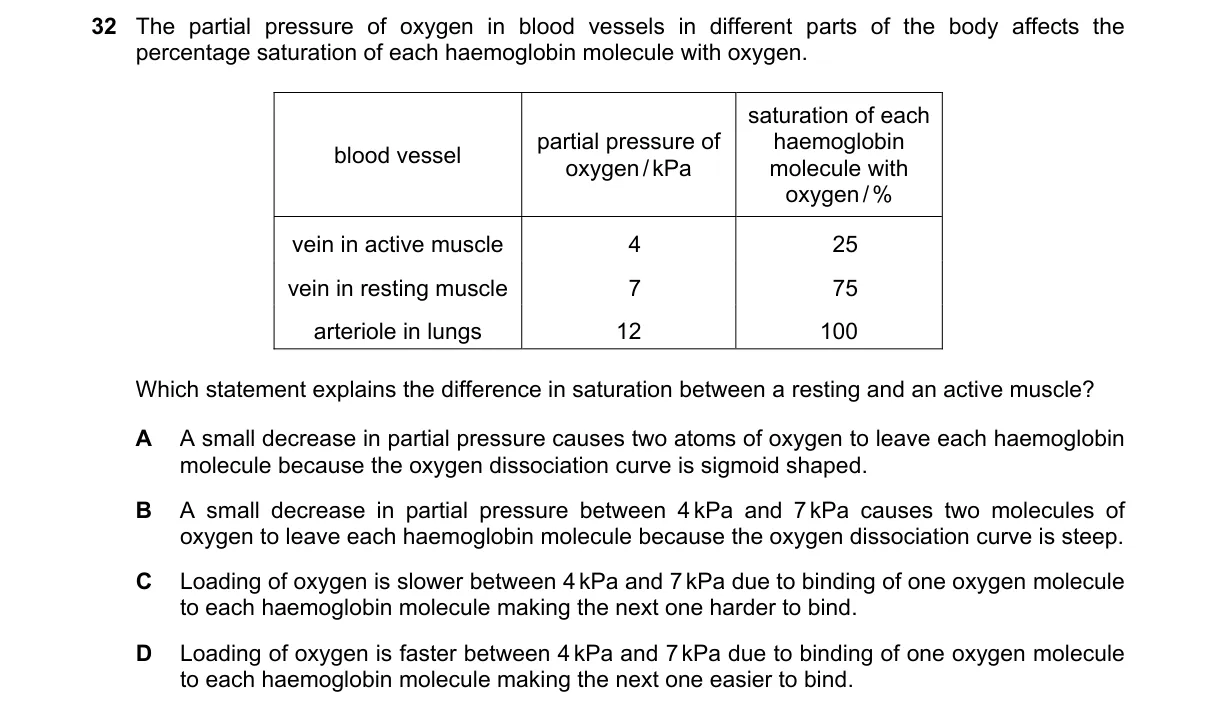
Answer choices
- AA small decrease in partial pressure causes two molecules of oxygen to leave each haemoglobin molecule.
- BA small decrease in partial pressure between 4 kPa and 7 kPa causes two molecules of oxygen to leave each haemoglobin molecule.
- CA small decrease in partial pressure causes two molecules of oxygen to leave each haemoglobin molecule because the oxygen dissociation curve is sigmoidal shaped.
- DA small decrease in partial pressure causes four molecules of oxygen to leave each haemoglobin molecule because the oxygen dissociation curve is sigmoidal shaped.
Explanation
Steep portion of oxygen dissociation curve enables efficient unloading
Steps:
- Recall sigmoidal oxygen-haemoglobin dissociation curve: flat at high PO2 (lungs), steep at tissue PO2 (2-6 kPa), flat at low PO2.
- Note resting muscle PO2 ≈5.3-7 kPa (high saturation, ~90-95%), active muscle PO2 drops to ≈2.7-4 kPa (saturation falls to ~50-70%).
- In steep region (4-7 kPa), small PO2 decrease causes large saturation drop, unloading ~2 O2 per haemoglobin (Hb carries 4 total).
- This explains greater oxygen delivery to active vs. resting muscle.
Why B is correct:
- Between 4-7 kPa lies the curve's steep slope, where small ΔPO2 unloads ~2 O2/Hb per Bohr effect definition, maximizing tissue delivery.
Why the others are wrong:
- A: Omits critical 4-7 kPa range; small ΔPO2 unloads little outside steep region.
- C: Includes sigmoidal shape but ignores specific pressure range needed for ~2 O2 unloading.
- D: Incorrectly states 4 O2 unload (full saturation drop requires larger ΔPO2); range unspecified.
Final answer: B
Topic: Transport of oxygen and carbon dioxide
Practice more A Levels Biology (9700) questions on mMCQ.me